FIBRUS ROUTERS AND EQUIPMENT REVIEW

Fibrus routers review: How good are they?

Fibrus matches two capable eero routers to its package speeds and supplies a two-node mesh from 500Mbps upwards. App controls are simple rather than advanced, but wider coverage and excellent freedom to use your own router lift the overall package.
By Data checked  Checked weekly
Fibrus routers and equipment hero with FibreDog holding an Amazon eero 7

Fibrus routers and equipment scorecard

Six key areas. One overall score. All calculated using our transparent methodology.

Wi-Fi quality

How good the standard routers’ Wi-Fi is in everyday use, looking at specifications, Wi-Fi bands/type, and how many devices they can support.

7.1/10

Wi-Fi range

How far the router’s Wi-Fi should reach around the home, with consideration given to local factors like large homes or thick walls.

7.0/10

Whole-home Wi-Fi

Whether the provider offers a mesh router system or extra help for larger homes, whether it’s good, and whether it’ll cost you extra.

7.5/10

Wired connectivity

How well the router supports Ethernet and wired devices, looking at number of ports, their speeds, and how accessible they are.

6.5/10

Router controls

How much control you get through the app, admin page and any controls you might have on the router itself.

6.8/10

Using your own router

How easily you can use your own third-party router or mesh hardware – whether you can use anything you like or if it’s limited in any way.

9.9/10

Wi-Fi quality

Fibrus supplies the dual-band eero 6+ on lower packages and the dual-band eero 7 on its two fastest tiers. Both cover everyday Wi-Fi well, although neither has a 6GHz band or advanced manual controls.

Key differences

Fibrus matches each eero to the speed of the package

Full Fibre 150, 300 and 500 use the Wi-Fi 6 eero 6+, which supports beamforming, OFDMA, WPA3 security, guest Wi-Fi and automatic traffic management. Full Fibre 1Gbps and 2Gbps receive the Wi-Fi 7 eero 7 instead, giving faster packages hardware that can actually handle their higher speeds.

Wi-Fi 7 arrives on the two fastest Fibrus packages

The eero 7 supports newer Wi-Fi 7 devices and up to 120 connected devices, compared with 75 on the eero 6+. It remains a dual-band router using 2.4GHz and 5GHz, however, so it doesn’t include the cleaner 6GHz band found on more expensive tri-band systems. It’s the standard eero 7, not the higher-specification eero Pro 7 that’s sometimes pictured standing upright.

The eero 7 is ready for multi-gigabit wired speeds

Both Ethernet sockets on the eero 7 run at 2.5Gbps, allowing the router to receive Fibrus’s 2Gbps service and pass more than 1Gbps to one suitably equipped wired device. The eero 6+ has two Gigabit Ethernet sockets instead. One socket is normally used by the fibre equipment on the wall, leaving one for a computer, console or Ethernet switch. Neither router has a telephone socket because Fibrus Talk uses a separate adapter.

Why two mesh units help

Fibrus supplies two eero units from 500Mbps upwards. In a home with several rooms or floors, placing a second node nearer the weak area can improve everyday Wi-Fi more than concentrating every feature in one router beside the fibre connection.

INTERACTIVE TOOL

Compare routers from any provider

This provider’s routers are pre-selected for comparison with one another. However, you can use this tool to compare any router from any major provider using the dropdown menus below.

Feature Amazon eero 6+ Amazon eero 7
Fibredog rating 6.4/10 7.0/10
Router included as standard Yes; supplied on the 150Mb, 300Mb and 500Mb tiers. Fibrus currently supplies one unit on 150Mb and two on 500Mb; allocation can vary by package. Yes; two units are supplied on the 1Gb and 2Gb tiers.
Router manufacturer Amazon eero Amazon eero
Router model R010001 PA10001
Wi-Fi standard Wi-Fi 6 Wi-Fi 7
Wi-Fi bands Dual-band Dual-band
2.4GHz supported ✓Yes ✓Yes
5GHz supported ✓Yes ✓Yes
6GHz supported ×No ×No
Beamforming ✓Yes ✓Yes
Antenna count 2 2
Maximum connected devices Up to 75 Up to 120
Stated coverage Up to 1,500 sq ft per unit Up to 2,000 sq ft per unit
Total Ethernet ports 2 2
MU-MIMO ×No ×No
OFDMA ✓Yes ✓Yes
WPA3 security ✓Yes ✓Yes
Guest network ✓Yes ✓Yes
Antenna type Internal Internal
Gigabit Ethernet ports 2 0
2.5Gb Ethernet ports 0 2
5Gb Ethernet ports 0 0
10Gb Ethernet ports 0 0
WAN port speed 1Gbps 2.5Gbps
USB ports 0 0
Telephone ports 0 0
ONT Ethernet input ✓Yes ✓Yes
Coaxial input ×No ×No
Power connection USB-C / external 15W power adapter USB-C / external 15W power adapter
Mesh support Provider mesh add-ons Provider mesh add-ons
Provider mesh product Total Home Wi-Fi Guarantee Total Home Wi-Fi Guarantee
Third-party router use You can use your own router You can use your own router
Modem mode ✓Yes ✓Yes
Compatible broadband technology fttp fttp
App management ✓Yes ✓Yes
Parental controls ✓Yes ✓Yes
QoS ✓Yes ✓Yes
Automated QoS ✓Yes ✓Yes
Device prioritisation ×No ×No
Anti-bufferbloat controls ✓Yes ✓Yes
Manual queue management (SQM/CAKE) ×No ×No
Smart channel selection ✓Yes ✓Yes
Security features WPA2/WPA3; TLS cloud connectivity; guest isolation; Profiles; automatic security updates; optional eero Plus filtering and ad blocking WPA2/WPA3; TLS cloud connectivity; guest isolation; Profiles; automatic security updates; optional eero Plus filtering and ad blocking
Gamer mode ×No ×No
Game traffic prioritisation ×No ×No
Gaming QoS profiles ×No ×No
Server ping routing tools ×No ×No
Latency dashboards ×No ×No
Per-device gaming presets ×No ×No
Gaming VPN routing features ×No ×No
Work from home mode ×No ×No
Automatic firmware updates ✓Yes ✓Yes
Firmware update notes eeroOS updates are pushed automatically on a rolling basis; customers can choose a preferred update window or install an available update manually. eeroOS updates are pushed automatically on a rolling basis; customers can choose a preferred update window or install an available update manually.
Router height 66mm 64mm
Router width 99mm 130mm
Router depth 97mm 130mm
Router weight 315g 606g
Power consumption 15W 15W
Router orientation Horizontal Horizontal
Wall mountable ×No ×No
Router colour White White
Self-installation ✓Yes ✓Yes
Browser admin interface ×No ×No
WPS ×No ×No
Status light control ✓Yes ✓Yes
Reset button ✓Yes ✓Yes
Wi-Fi on/off button ×No ×No
Where would you like to go next? See all tools See all tools
Compare all broadband deals

Two capable eero models, assigned by package

Amazon eero 6+

Included on 150Mbps, 300Mbps and 500Mbps packages

Dual-band Wi-Fi 6, two Gigabit Ethernet sockets and support for up to 75 connected devices

Amazon eero 7

Included on 1Gbps and 2Gbps packages

Dual-band Wi-Fi 7, two 2.5Gbps Ethernet sockets and support for up to 120 connected devices

The practical difference

Faster packages receive the faster router

Both models automate routine Wi-Fi management, while the eero 7 adds device capacity and multi-gigabit wired speed rather than a 6GHz band.

What actually changes between the two supplied eeros

The eero 6+ is a compact Wi-Fi 6 router designed to sit flat on a table or shelf. It covers the needs of the lower Fibrus tiers without asking customers to configure radio channels or traffic rules themselves.

The eero 7 moves to Wi-Fi 7 and raises stated coverage from up to 1,500 square feet to up to 2,000 square feet per unit. Its two 2.5Gbps Ethernet sockets also suit the 2Gbps package, whereas the eero 6+ is limited to Gigabit Ethernet.

Both exact models have two internal antennas, beamforming, OFDMA and automatic Smart Queue Management. The published specifications for these exact models don't list MU-MIMO or a 6GHz band, so the supplied eero 7 shouldn't be confused with Amazon's more expensive Pro model.

The package allocation matters as much as the specification. A 500Mbps customer receives two eero 6+ units, while 1Gbps and 2Gbps customers receive two eero 7 units. That second node can make a larger difference around the home than a newer Wi-Fi label by itself. It's a sensible trade-off for households where dependable coverage matters more than an impressive specification sheet.
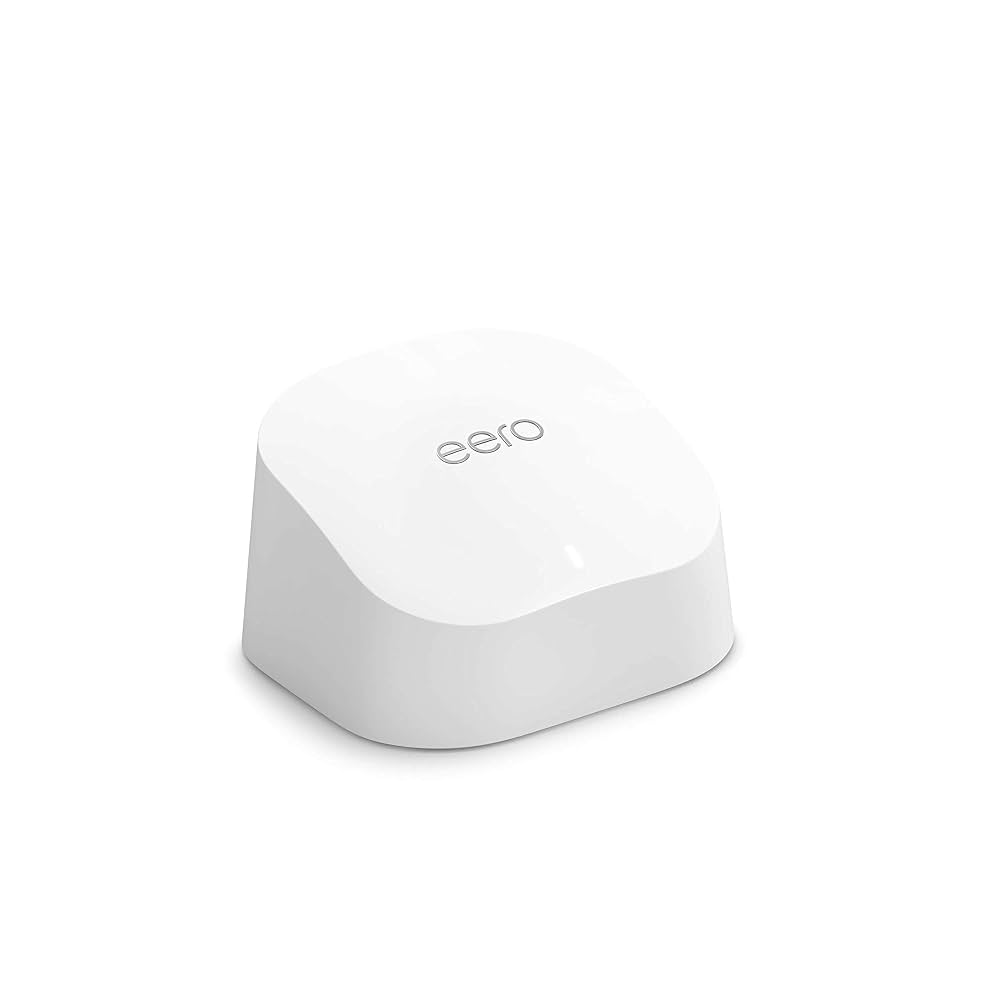
Amazon eero 6+

Fibrus supplies good Wi-Fi hardware and sensibly reserves the faster eero 7 for packages that can use its multi-gigabit connections. The eero 6+ remains capable on lower tiers, while two units from 500Mbps upwards improve the chance of useful coverage beyond the room containing the fibre connection. Neither router includes 6GHz Wi-Fi, and the app favours automation over detailed tuning. Those limitations keep the Wi-Fi package from being exceptional, but most households get well-matched equipment without paying for a router upgrade.

7.1 /10
Overall score

Wi-Fi quality score

This score is based on the router’s Wi-Fi standard, frequency bands, device capacity and key wireless features such as beamforming, MU-MIMO and OFDMA.

Router range

Fibrus combines respectable single-unit coverage with a more practical option for larger homes: two mesh nodes from 500Mbps upwards. Manufacturer figures remain best-case estimates rather than promises for every property, so walls, floors and placement still decide how well either eero reaches each room. The second unit provides a practical way to work around those obstacles.

One eero covers well, but the second changes the calculation

Amazon states coverage of up to 1,500 square feet for one eero 6+ and up to 2,000 square feet for one eero 7. Those numbers are useful for comparing the two models, not promises for a particular house. Thick stone walls, foil-backed insulation, large mirrors and several floors can all shorten the real range. The units are compact and sit flat, which makes them easy to place in the open, but hiding one in a cupboard wastes that advantage.

Walls and floors still decide where the signal reaches

A nearby room separated by plasterboard is much easier to cover than a loft office behind brick, insulation and two floors. Package speed can't overcome those physical barriers, so a weak room usually needs better eero placement or another mesh node.

Two nodes can beat one router with a bigger claim

One eero beside the fibre connection still has to push Wi-Fi through every wall and ceiling between it and the device. The stated square-foot figure can't show where those obstacles sit.

From 500Mbps upwards, Fibrus supplies a second matching eero. Placing it between the main unit and a weak room gives devices a nearer Wi-Fi source, although the two eeros still need a healthy connection to each other. This distributed approach is usually more helpful across several rooms or floors than expecting one router to overpower the building.

A third eero supports the room-speed guarantee

Fibrus's whole-home route starts with troubleshooting and the two supplied units on eligible packages. If those steps don't deliver the guaranteed room speed, Fibrus can supply a third eero at no extra cost. That gives customers a practical remedy rather than asking them to rely on the coverage estimate alone. The documented maximum through this guarantee route is three, and the 150Mbps package begins with one unit, so package eligibility still needs checking.

INTERACTIVE TOOL

Router range estimator

See how wall materials and router choice affect the quality of Wi-Fi around a typical home.
What are your internal walls mostly made from?
Which of these routers are you estimating?
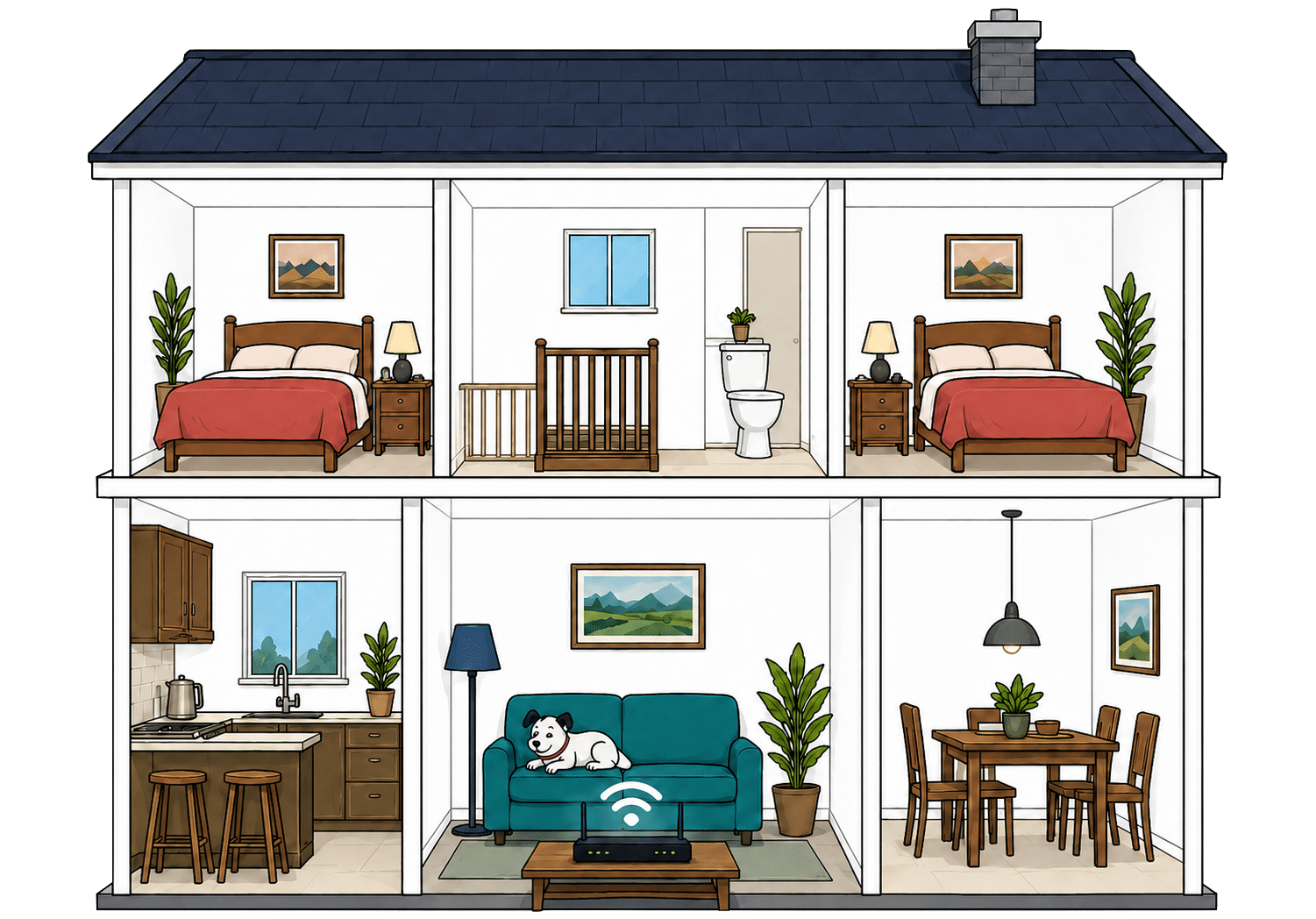
Cutaway illustration showing connected devices throughout a family home
Perfect reception – strong, reliable Wi-Fi. Average reception – slower speeds may happen. Poor reception – weak signal or drop-outs.

Where would you like to go next?

Use the estimate as a starting point

Select the exact eero and the main wall material in your home. The result gives a rough single-unit range, not a promise that every room will receive the same speed.

Compare the estimate with the rooms where Wi-Fi is actually used. Neighbouring networks, furniture, mixed wall materials and the position of the fibre connection can all change the result. A real speed test in the weak room is more useful than treating the estimate as a guarantee.

How to get the best range from Fibrus eeros

  1. Give eero some space

    Place it on a table or shelf, clear of cupboards, large metal objects and the television. Wi-Fi needs space to leave the router.

  2. Test the weak rooms

    Run speed tests where people actually work, stream or play. The slow room, not the fastest room, tells you whether placement needs attention.

  3. Use the eero app

    Check which eero each device uses and whether the mesh units have a healthy connection. The app can expose poor placement before furniture starts moving.

  4. Move obvious blockers

    Keep each eero away from mirrors, appliances, thick walls and anything that boxes it in. A small move can improve the path between nodes.

  5. Use the second eero properly

    Place it before the dead zone, not inside it. The second unit needs a usable signal from the first before it can extend coverage onwards.

Faster Wi-Fi still travels a shorter distance

Wi-Fi behaves a little like sound through walls. Lower frequencies travel further, while higher frequencies can carry more data nearby but fade sooner. That's why the quickest reading beside an eero may not survive several rooms and floors unchanged.

The 2.4GHz band is slower but generally reaches further through the home. The 5GHz band is faster near an eero and better suited to large downloads, streaming and gaming, but physical barriers reduce it more quickly. Both Fibrus routers use these two bands and move devices between them automatically.

The eero 7 adds Wi-Fi 7 but remains dual-band, with no 6GHz radio. Its newer technology can improve efficiency with compatible devices, yet it doesn't abolish the old range problem. Two well-positioned nodes will usually do more for a distant room than a newer Wi-Fi label on one unit beside the ONT.

Fibrus offers good router range, especially on packages that include two eero units. The quoted coverage figures are useful comparisons rather than room-by-room promises, and thick walls or several floors can still defeat a poorly placed node. Fibrus responds sensibly by distributing the signal instead of relying on one gateway: customers from 500Mbps upwards begin with two units, while eligible homes can receive a third through the Wi-Fi guarantee after troubleshooting. The 150Mbps tier is less generous because it starts with one eero.

7.0 /10
Overall score

Router range score

This score estimates how well the provider’s standard routers are likely to deliver usable Wi-Fi speeds around a typical home, not just whether a faint signal reaches the back bedroom.

Whole-home Wi-Fi

Fibrus's whole-home Wi-Fi offer is one of the better parts of its equipment package. Customers from 500Mbps upwards start with two matching eero units, and eligible homes can receive a third at no extra cost if initial troubleshooting still doesn't meet the room-speed guarantee.

Two eeros come with the faster packages

Full Fibre 500, 1Gbps and 2Gbps customers receive two eero units as standard. The nodes form one mesh network, allowing phones and laptops to move around the home without choosing separate Wi-Fi names. This is more convenient than running two unrelated networks and gives the second unit a proper role in extending coverage.

Full Fibre 150 starts with one eero, so the exact package allocation matters before assuming every Fibrus customer receives a two-node system.

A third unit is the guarantee remedy

If the included setup doesn't achieve the guaranteed room speed after Fibrus troubleshooting, Fibrus can send a third eero without an extra charge. It's only supplied after troubleshooting confirms that it's needed.

The documented provider-supplied maximum is three: two included on faster packages and one more where needed. Fibrus doesn't publish a wider overall ceiling for customers who want to buy additional nodes separately.

Including two nodes is the real advantage

Many providers include one router and charge separately for every extender. Fibrus instead gives customers on 500Mbps and faster packages a working two-node mesh from the start. That's a more useful benefit for a home spread across several rooms or floors than adding another headline feature to one router. Both units are managed together through the eero app, and customers don't have to create a second Wi-Fi network or manually move devices between access points.

The guarantee provides a useful fallback, but the third unit is conditional. Fibrus expects customers to complete troubleshooting first, and the room-speed guarantee only applies to eligible packages and homes. The remedy is another eero, not a cash payment. That's still better than being told to buy an extender immediately, provided the customer follows the support process and allows the mesh placement to be checked.

The practical maximum is three provider-supplied units: two included on faster packages, then one more if the guarantee process shows it's needed. That's enough for many larger homes without turning the network into a chain of unnecessary nodes. More eeros don't automatically mean better Wi-Fi because each unit still needs a reliable route back to the main connection.

INTERACTIVE TOOL

Whole Home Wi-Fi Calculator

Just follow these simple steps and we will calculate how many, if any, ‘Whole Home Wi-Fi’ pods you will need from your provider.

Start here. Work through the steps in order.

Upload — Mbps
Latency — ms

Step 1: Agree to M-Lab’s data policy

M-Lab stores test data, including your IP address. Tick to agree before testing.

Step 2: Connect to your home Wi-Fi

Make sure the phone, tablet or laptop you are using is connected to your home Wi-Fi network.

Step 3: Turn mobile data off

If your device has mobile data, turn it off before you start walking around the house.

Step 4: Test next to your router

Stand next to your main Wi-Fi router and press the button below. This gives us your baseline speed.

Recorded result Router baseline
— Mbps

Step 5: Test your ground floor corners

Walk to each corner of your ground floor and run a test. If your home is not a perfect rectangle, do not overthink it. Just pick four sensible far-apart spots and keep the same numbering if you add another floor.

Corner 1 — Mbps
Corner 2 — Mbps
Corner 3 — Mbps
Corner 4 — Mbps

Last step: Add another floor or calculate

If you have another floor to test, add it below. If you have tested every floor you care about, press calculate.

Your Whole Home Wi-Fi result

Result waiting Run your tests, then press calculate.

    Where would you like to go next?


    Fibrus whole-home Wi-Fi in brief

    Find the weak room

    Test where Wi-Fi is actually used, especially behind thick walls or on another floor.

    Use the calculator first

    Estimate how many nodes the layout may need before changing package.

    Two units from 500Mbps

    Faster packages begin with a two-node mesh rather than one isolated router.

    A third can be free

    Fibrus can provide another eero when eligible guarantee troubleshooting confirms the need.

    Coverage, not extra speed

    The additional nodes improve reach around the home; they don't increase the broadband package speed.

    Fibrus provides a good whole-home Wi-Fi route. Two eero units are included from 500Mbps upwards, giving many larger homes useful mesh coverage without a separate monthly add-on. If eligible rooms still fall below the guarantee after troubleshooting, a third unit can be supplied at no extra cost. The 150Mbps package begins with one eero, and the third node is a remedy rather than an automatic entitlement. Even with those conditions, two supplied units plus a possible third is a generous and practical approach.

    7.5 /10
    Overall score

    Whole-home Wi-Fi score

    This score estimates how well the provider helps customers fix Wi-Fi weak spots around the home, including mesh support, mesh devices, app control, Wi-Fi guarantees and router capability.

    Wired connectivity

    Fibrus's routers have only two Ethernet sockets, and the ONT normally occupies one. That leaves one wired connection for a device or switch. Both eero 7 sockets run at 2.5Gbps, allowing one compatible wired device to receive more than 1Gbps, while a simple switch handles households needing more ports. Most homes will find that a fair trade for receiving a distributed mesh system instead of one router.

    One usable socket is enough for many homes

    The eero 6+ has two Gigabit Ethernet sockets. One connects to the ONT, leaving the other for a desktop computer, console, television or Ethernet switch. That's limited beside a traditional four-port router, but many households only need one permanent wired connection.

    A small Ethernet switch turns that remaining socket into several LAN ports. It adds one box and power cable, but it's inexpensive and avoids sacrificing Fibrus's more useful decision to supply two mesh units on faster packages.

    The eero 7 properly supports the 2Gbps package

    Both sockets on the eero 7 run at 2.5Gbps. After one connects to the ONT, the remaining socket can deliver more than 1Gbps to a compatible computer, switch or other device. That gives the fastest Fibrus package a genuine multi-gigabit wired route rather than limiting every device to Gigabit Ethernet.

    Only one device can connect directly because there's still just one free socket. A 2.5Gbps Ethernet switch is needed when several wired devices must share multi-gigabit speeds. A cheaper Gigabit Ethernet switch is sufficient when the extra devices only need up to 1Gbps.

    Illustration of Fibo comparing different wired network connections

    How a simple wired Fibrus network works

    Plugging devices directly into your router gives them a steadier connection than Wi-Fi. These router diagrams show the physical Ethernet ports, including any ONT or internet port used by the broadband connection itself.

    Amazon eero 6+
    1 ONT / internet port 1Gbps
    1 usable port 1Gbps 1Gbps
    Amazon eero 7
    1 ONT / internet port 2.5Gbps
    1 usable port 2.5Gbps 2.5Gbps
    ★

    Use a wired connection for TVs, consoles and computers that stay in one place.

    ✓

    Use the fastest spare LAN port for the device or switch that needs the most speed.

    Ethernet is still best for devices that stay put

    A console or gaming computer gains a stable local connection without walls, wireless interference or competition from nearby Wi-Fi devices. It's the most dependable setup for online play.

    A work computer or network storage device also benefits when large files move regularly. The cable can't improve Fibrus's wider network, but it removes Wi-Fi variation inside the home.

    Televisions and streaming boxes rarely need enormous speed, yet Ethernet can prevent buffering caused by a weak signal in a fixed location.

    Phones and tablets gain little from a cable, so leave the wired socket for equipment that stays in one place and benefits from consistency.

    How to make best use of the two Ethernet sockets

    1. Count the usable sockets

      One socket connects to the ONT, so plan around a single free LAN connection on either eero.

    2. Gigabit Ethernet suits the lower packages

      The eero 6+ can carry the full speed of Fibrus packages up to 500Mbps through its wired connection.

    3. Use 2.5Gbps equipment above a gigabit

      The eero 7 supports multi-gigabit Ethernet, but the computer, cable and any switch must also support 2.5Gbps.

    4. Wire the devices that care

      Give the direct connection to a console, desktop or work computer that benefits from steady speed and latency.

    5. Add a switch when needed

      A small switch adds as many wired ports as the household needs. Choose 2.5Gbps only when devices genuinely use multi-gigabit speed.

    Fibrus's wired connectivity is decent rather than generous. Both routers leave only one socket free after the ONT connection, so several wired devices need an Ethernet switch. That's a minor inconvenience because one direct port is often enough and a switch expands it cheaply. The eero 7 deserves credit for making both sockets 2.5Gbps, allowing the 2Gbps package to reach one compatible device at full speed. Multi-port routers remain tidier for heavily wired homes.

    6.5 /10
    Overall score

    Wired connectivity score

    This score looks at how useful the router is if you want to plug devices in with cables, including the number of Ethernet ports, port speeds, phone ports and whether the router has the right connection for the network it uses.

    Router controls

    Fibrus keeps router control simple through the eero app. Everyday jobs are easy and important maintenance happens automatically, but there's no browser admin page or detailed manual traffic tuning for advanced users.

    The eero app covers the everyday controls well

    Customers can view connected devices, create household profiles, manage parental controls, set up guest Wi-Fi and control the status light from the eero app. The same interface manages every node in the mesh, so there's no separate extender login to remember.

    Some filtering and security features sit behind the optional eero Plus subscription. The standard controls still cover routine household administration without requiring it.

    Firmware updates arrive automatically, with a preferred update window available, while automatic Smart Queue Management reduces delay when several devices are busy. This suits customers who want the router to look after itself rather than learn traffic rules.

    There's no browser admin page

    All normal management happens through the eero app and its cloud service. Customers accustomed to typing a router address into a web browser won't find a traditional local control panel, and detailed radio settings are deliberately hidden. That makes setup cleaner for most people but leaves advanced users with fewer ways to inspect or tune the network.

    Several advanced controls are absent, but the automatic features do useful work

    Neither eero offers WPS, a dedicated gaming mode, a work-from-home mode or a simple manual button that permanently prioritises one device. There's also no exposed manual queue-management screen.

    The routers handle channel choice, software updates and queue management automatically. That approach prevents many poor settings and reduces maintenance, although it also means enthusiasts can't choose channels, split every radio option or build detailed traffic rules themselves. The eero app is designed around profiles and devices rather than a page full of networking switches.

    Optional eero Plus services can add filtering and ad blocking, but they may require a separate subscription. The everyday value comes from the included profiles, guest network, automatic security updates and mesh management rather than paid extras for most homes.

    Router controls

    Fibrus router controls at a glance

    Here’s a quick look at the router controls you can expect, including app management, browser admin tools, Wi-Fi settings, security features and the physical buttons on the router itself.

    App management App-based controls Available
    Browser admin page Browser-based controls Unavailable
    Parental controls Household controls Available
    Guest network Separate guest Wi-Fi Available
    QoS Traffic priority controls Available
    Device prioritisation Per-device priority Unavailable
    Smart channel selection Wi-Fi optimisation Available
    Security features Built-in security notes Available
    Automatic updates Firmware updates Available
    WPS Push-button pairing Unavailable
    Reset button Physical reset control Available
    Wi-Fi on/off button Physical Wi-Fi control Unavailable

    Checked from manufacturer specifications. Fibredog tracks dozens of router specification parameters across dozens of provider routers. When a provider changes its router or features, this table is swiftly updated.

    What stands out

    • Control through one app

      Devices, profiles, guest access and every eero node sit together in one clear mobile interface.

    • Browser controls are absent

      There's no traditional local admin page for customers who prefer detailed settings on a computer.

    • Easy basics, limited manual control

      Automatic updates and traffic management reduce work, but advanced users get very little direct tuning.

    Fibrus offers useful controls for household jobs. The eero app makes devices, profiles, parental controls, guest Wi-Fi and mesh nodes easy to manage, while automatic updates and Smart Queue Management reduce maintenance. Advanced users get less freedom because there's no browser admin page, WPS, manual device priority or dedicated gaming and work modes. Optional eero Plus features may also cost extra. Most customers get an approachable interface, but anyone wanting detailed network control will prefer another router.

    6.8 /10
    Overall score

    Router controls score

    This score looks at how easy the router is to manage, including app support, browser settings, parental controls, guest Wi-Fi, security features, updates and physical buttons.

    Using your own router

    Fibrus is exceptionally flexible about third-party routers. A compatible replacement can connect directly to the FTTP Ethernet hand-off, or the supplied eero system can remain in bridge mode while another router handles routing. The customer takes more responsibility for setup and faults, but Fibrus doesn't lock the connection to its own gateway.

    Using your own router with Fibrus, step by step

    Check that the replacement is suitable

    Choose a router with an Ethernet WAN socket and support for the speed of the Fibrus package. A 2.5Gbps WAN port is needed if one device is expected to use more than 1Gbps on the fastest tier.

    Disconnect the main eero from the ONT

    The fibre box on the wall stays in place. Only the Ethernet cable leading to the main eero changes.

    Keep every supplied eero and its power adapter safely stored. Fibrus may ask for the original equipment during fault checks or after cancellation.

    Connect the replacement router by Ethernet

    Run an Ethernet cable from the ONT to the replacement router's WAN socket.

    Use a suitable cable and 2.5Gbps socket for multi-gigabit service. A Gigabit Ethernet WAN connection limits one device to roughly 1Gbps.

    Enter the current connection settings

    Ask Fibrus for any connection details the replacement router needs, then enter them in its internet settings.

    Don't copy settings from an unrelated provider guide. The exact details can change, and Fibrus support should confirm the current values for the customer's connection.

    Test the connection properly

    Begin with one computer connected by Ethernet and confirm that internet access is stable.

    Then set the Wi-Fi name and password, reconnect household devices and check the rooms where coverage previously mattered.

    Keep the eero available if support asks for a test with supplied equipment. A fault that disappears when the eero is restored may sit with the customer-owned router rather than the Fibrus line.

    Fibrus supports full replacement and bridge mode

    Customers can replace the eero completely at the Ethernet hand-off. The third-party router then handles the internet connection, Wi-Fi, wired devices and all household controls.

    Alternatively, eero bridge mode keeps the mesh units providing Wi-Fi while another router handles routing. Some eero functions are disabled in bridge mode, so it isn't identical to the normal eero setup.

    Get the settings directly from Fibrus

    Fibrus should confirm any current connection details needed by the replacement router. This avoids relying on an old forum post or another customer's setup, and gives support a clear starting point if the new router doesn't connect.

    Support for the broadband line remains separate from support for customer-owned equipment. Fibrus may ask for its eero to be reconnected before investigating a fault, while setup, software updates and faults inside the replacement router remain the customer's responsibility.

    Change router for control, not because the eeros are poor

    The supplied eero 6+ and eero 7 already provide good automatic Wi-Fi, mesh support and straightforward app control. Replacing them solely because a retail router has a longer feature list may add complexity without improving coverage.

    A third-party router makes sense when it solves a specific problem: more wired ports, a preferred mesh system, detailed parental rules, manual traffic control or specialist security. The direct Ethernet hand-off and bridge mode make either option unusually straightforward.

    Why you might still prefer your own router

    You already own a capable router

    Reusing a router that already covers the home well can preserve familiar settings and avoid rebuilding every device rule.

    You prefer another mesh system

    A trusted retail mesh may suit the home's layout or existing wired backhaul better than the supplied eeros.

    You need specialist controls

    Manual traffic rules, VPN routing, detailed radio settings or gaming features require equipment designed to expose them.

    You prefer different parental controls

    Another platform may offer schedules, reports and filtering that better match the household's needs.

    You want to keep existing settings

    Reusing Wi-Fi names, passwords, device reservations and security rules can save considerable setup across a busy home.

    You need features eero doesn't offer

    A browser admin page, WPS or manual device priority requires a different router rather than another eero node.

    Amazon eero 6+

    What changes when you use your own router?

    A direct replacement connects at the ONT and removes the main eero from the active setup. Bridge mode instead keeps the eero mesh for Wi-Fi while another router takes control of routing.

    The ONT

    The broadband connection passes to your router

    The ONT remains fixed to the wall and continues to deliver the Fibrus connection through Ethernet.

    The replacement router accepts that Ethernet connection using the current settings supplied or confirmed by Fibrus.

    Your own router

    It takes over Wi-Fi and settings

    The customer's router handles Wi-Fi names, passwords, wired devices, parental controls, security and any specialist features it provides.

    The customer also manages setup, software updates and router faults. Keep the supplied eeros for support checks and any later equipment return.

    Fibrus is exceptionally accommodating when customers want different equipment. A compatible router can connect directly at the FTTP Ethernet hand-off, while bridge mode allows another router to take control without discarding the eero mesh. This gives customers genuine choice over Wi-Fi, wired ports, parental controls, security and specialist features. Fibrus may ask for its own eero to be restored during fault checks, and customer-owned equipment brings responsibility for setup, updates and router faults. Those are reasonable conditions beside the freedom on offer, especially because the supplied eeros remain available as a fallback.

    9.9 /10
    Overall score

    Using your own router score

    This score reflects how well the provider supports third-party router use, including ONT or modem-mode setup, WAN port speed, connection type and how cleanly your own router can take over the home network.

    Some links on this page may earn us a small commission if you click through and buy. This never affects either what you pay, or our scores and recommendations. If, however, you’d rather bypass affiliate links, use this direct Fibrus link instead.

    Illustration of Fibo representing direct links to broadband providers