
EE BROADBAND CONTRACTS AND SMALL PRINT REVIEW

EE Broadband contracts and small print: How friendly are they?

Unlike some providers, EE Broadband doesn’t have one, simple copy of your broadband contract to offer you, and instead spreads things around in four or five individual terms and conditions documents. That makes finding terms harder than it needs to be. Luckily, you have us to turn to!

By Data checked  Checked weekly
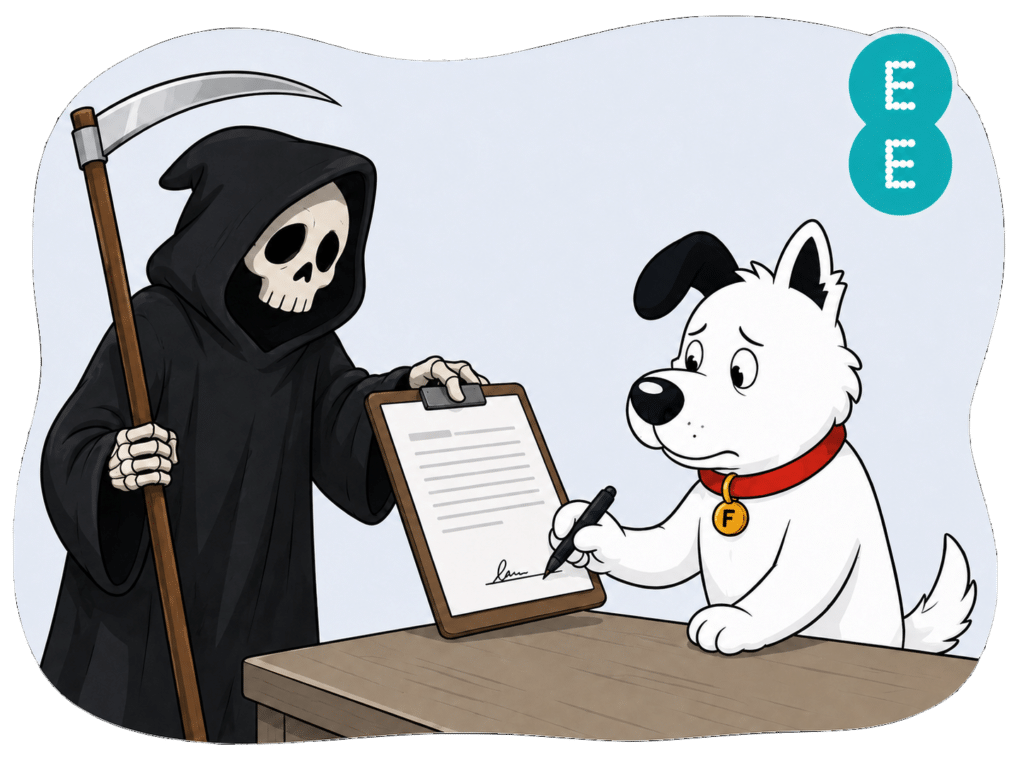
The fibredog mascot dog signing an EE Broadband contract held out by the grim reaper, denoting that signing without reading all EE Broadband contracts and small print terms can be risky
fibredog mascot wearing a headset

Having trouble choosing a broadband provider?

No single best provider or package exists – only the best pick for you personally. Fibredog’s YourMatch™ system uses thousands of provider metrics and a lot of maths to find you your perfect match.

EE Broadband contracts and small print scorecard

Six key areas. One overall score. All calculated using our transparent methodology.

Contract commitment

How restrictive the core contract is, including minimum terms, rolling options, notice periods and what happens when the deal ends.

6.9/10

Price rise terms

How clearly price increases are explained, including fixed annual rises, inflation clauses, timing and any terms that could change the bill.

6.8/10

Early-exit fees

How expensive it can be to leave early, including calculation methods, remaining-contract charges, caps and whether future rises are included.

8.3/10

Speed guarantees

How meaningful the speed promises are, including minimum guaranteed speeds, fault routes, cancellation rights and any service-code protection.

6.1/10

Equipment ownership

What happens to supplied equipment, including ownership, return deadlines, packaging, collection options and any non-return charges.

7.7/10

Hidden catches

How many awkward details sit in the small print, including unusual restrictions, extra obligations and terms that are easy to miss.

6.4/10

Contract commitment

Here, we're going to look at how EE treats contract length, what happens when your minimum term ends, how much notice you need to give, and the things that can start a new minimum term.

EE Broadband contracts are either 12 or 24 months long

You wouldn't know it from visiting a so-called 'comparison' website, but EE Broadband actually offers a shorter contract if you want it. And yes, there's a catch – there's always a catch: 12-month contracts will cost you substantially more than if you tie yourself in for two years.

Shorter contracts are easier to escape from if your circumstances change, so two years is still the proper lock-in, but EE will let you stay for a shorter period if you're prepared to pay for the privilege. Whichever contract you choose, if you leave before the minimum term ends, EE will charge an early termination fee, unless of course one of the contract's listed exceptions applies to you.

Your EE broadband keeps going after your contract ends

The end of your minimum term is not a switch-off date. EE says your service carries on unless you end it in one of the ways set out in the agreement, or EE ends it for some reason itself. So doing nothing doesn't cancel anything. It just means the service continues.

It's pretty useful if you want your broadband to keep working without any hassles, but it also means your broadband bill will keep climbing year-on-year. Switching is sometimes the better option if paying the least amount possible is the goal. EE says you must give 14 days' notice if you're switching through an approved switching process, or 30 days' notice if you're cancelling for any other reason. EE can also agree a new minimum term later, but says it will tell you beforehand.

Contract loop explained

The EE broadband contract loop

You get the lowest price from a new contract, and EE broadband does not apply an additional end-of-contract price increase when the minimum term ends.

Your choice point

Switch, haggle, recontract, or roll on at the standard monthly price.

New deal Best monthly price, but the clock is now ticking.
Locked in For 24 months, unless you switch to a provider with broadband buyout.
Term ends You should already have renegotiated or switched by now.
Annual rises add up Your deal avoids an extra end-of-contract jump, but annual increases can still make it less competitive.
Sign up or recontract Best value

During your first term, it's as cheap as it gets. Sometimes you can get close when negotiating a second term.

Switch or recontract Most flexible

Thanks to broadband buyout schemes, you can often switch up to six months before your contract ends.

Do nothing Not ideal

EE broadband does not add a further price increase when your minimum term ends, but annual price rises may still leave you paying more than a new customer.

INTERACTIVE TOOL

When can I switch to a new provider?

See whether the provider you want to move to may cover your current broadband early exit fee.

Step 1: Which provider are you currently with?

Choose your current broadband provider.

Step 2: Which provider are you looking to move to?

Choose the provider you are thinking of switching to.

Step 3: How many months are left on your current contract with your current provider?

Enter the number of payments left, or tell us your minimum term has finished.

or

Step 4: How much are you paying per month?

Enter your current broadband monthly price.

£

Step 5: When can I switch to EE Broadband?

We calculate your current exit fee and compare it with the switching credit from the provider you want to move to.

Your switching result

    Where do you want to go next?
    EE's terms let you cancel at any time, but if you're still inside your minimum term, an early termination charge will apply. There are exceptions, including repeated faults, a significant breach by EE, a voluntary-code breach, or a home move where EE can't provide the same package at your new UK address.

    A new EE deal will mean a new minimum term

    EE says it can agree a new minimum term with you during or after your first one – so-called re-contracting. The example it gives is taking up one of its offers at the time, which is exactly the kind of thing that can happen when you renew, upgrade or haggle for a better deal.

    joining mascot

    EE broadband contracts are 24 months long, or 12 months if you’re prepared to pay substantially more for the privilege, so this is still a proper commitment rather than a short-term deal for most people. Your service keeps going after the minimum term ends, but leaving during the term will mean an early termination charge, and taking a new offer will start a fresh minimum term.

    0.0 /10
    Overall score

    Contract commitment score

    This score looks at how much commitment you're taking on when you sign up, and whether you've got any realistic ways to choose a shorter or more flexible contract.

    Price rise terms

    This section isn't just about EE's advertised annual price rise. We have that covered in the annual price rises section of our EE Value for Money review. No, this is about the wording of the contract, whether EE can raise charges beyond the scheduled yearly increase, and how much room it gives itself to change what you pay.

    Some price rise contract clauses are benign, others not so much

    The yearly rise is clear, but it isn't the only lever

    EE's contract says your monthly price will rise each year by the annual price rise amount. During your minimum term, that increase takes effect at midnight on 31 March. But after your minimum term, when you may find yourself on a rolling monthly contract, it takes effect on 1 March instead.

    That yearly rise won't give you the right to leave during the minimum term without paying an early termination charge. So the main rise is predictable, but it's also locked into the agreement from the start for everyone. The whole situation with annual price rises is a mess, truth be told – one that stems from providers competing at the cheapest possible entry point, rather than simply pricing things fairly and keeping those prices fixed. This isn't an EE-specific gripe, it's more a general gripe.

    Other charges sit outside the main price rise promise

    EE separates your monthly price from other charges. The contract says the amount you pay each month goes up by the annual price rise amount, while other charges, except add-ons, go up by the annual price rise percentage. Both should be set out in your order confirmation or notified to you, and also appear in the price guide. It is as clear as mud in all honesty.


    The easiest way to think about it is that your headline broadband price increase isn't the whole picture. Paper bills, late payment charges, reconnection charges, installation fees, extra usage or other billable items can still matter, because EE's terms treat them as charges under the wider agreement, not just as part of your monthly broadband price. EE doesn't write those prices into your contract document at all, which means that technically they can change them as they please. You just sort of have to trust that they won't.

    EE can up prices for broader business reasons too

    EE's contract gives it a separate route for upping various charges. It says charges may change if the cost of providing the service increases, if the cost of running EE's business increases, if EE reorganises the way it runs its business, or if a law, code, regulation, guidance or responsibility changes.

    That doesn't mean every change leaves you stuck with more to pay. But for changes outside the annual rise, EE says you may get notice and may have the right to end the agreement without an early termination charge, unless one of the contract's exceptions applies.

    Ofcom offices
    Ofcom Offices, London

    Where's Ofcom on all this?

    Ofcom has tightened the rules, but it hasn't made broadband contracts fully predictable. That's the awkward bit.

    What Ofcom fixed

    The April rise now has to be shown upfront

    Since 17 January 2025, providers can't use unknown future inflation to calculate in-contract price rises. If a price rise is written into your contract, it has to be shown clearly in pounds and pence before you sign up.

    That's a real improvement. You should be able to see the planned April increases before you're locked into a deal.

    What's still loose

    It isn't a full ban on extra price movement

    Ofcom's rules are mainly about making agreed price rises clear, not freezing every possible charge for the whole contract.

    If a provider raises prices beyond what you agreed, Ofcom says you should get notice and the right to leave penalty-free. That's useful, but it still isn't the same as a simple fixed-price contract.

    Sources: Ofcom, Guardian

    When your EE broadband bill can rise outside April

    The April rise is the headline one, but it isn't always the only route in the contract. These are the clauses that can push your bill up, plus the areas where you're less exposed.

    Most likely to matter

    Add-ons and extras aren't protected by the April promise

    You can still see add-ons, admin costs, paper billing, non-inclusive calls and other out-of-bundle charges change separately from the advertised April rise.

    Changing your package can change your bill straight away

    Adding, removing or reducing services can change what you pay outside the advertised April annual price rise.

    Fee clauses

    Cost-based fees can move when costs move

    EE broadband can change what you pay for charges linked to providing a service or carrying out a task, separate from the April rise.

    Missed payments can add extra charges

    If you pay late, miss a payment or a payment fails, you can face interest, default charges or bank-related charges separately from the April price rise.

    Not returning kit can get expensive

    If you don't return equipment, you can face replacement, recovery or legal recovery charges outside the advertised April rise.

    Outside EE broadband's control

    Law, tax and regulator changes can still hit your bill

    If law, VAT, tax, government, regulator or legal obligations change, you can see charges rise outside the advertised April rise.

    Some rates can follow wholesale costs

    If wholesale-linked rates change, such as international call rates, you can see those changes passed on separately from the advertised April rise.

    Less likely to matter

    Third-party charge changes aren't stated separately

    EE broadband doesn't state in its contract that third-party charge or term changes can raise your bill separately from the advertised April rise.

    Home moves aren't stated as carrying a transfer fee

    EE broadband doesn't state in its contract that moving home will trigger a transfer fee.

    Home moves aren't stated as starting a new minimum term

    EE broadband doesn't state in its contract that moving home will start a new minimum term.

    Legal or regulatory changes can also push prices up

    EE also protects itself against changes imposed from outside. Its contract says charges can change if there's a change in law, a code of practice, regulation, guidance or responsibility that applies to EE. It even gives a VAT increase as an example. EE can't change things at a whim, but there are plenty of circumstances where it might.

    EE Broadband's yearly price rises are clear enough, but it isn't the only lever in their contract. Add-ons, package changes, missed-payment charges, equipment fees and some outside changes can still push your bill up beyond the advertised April rise, and if EE wants to score better here, it’s going to need to stop stuffing its contracts with exceptions.

    0.0 /10
    Overall score

    Price rise terms score

    This score looks at how much protection you've got against extra price increases or added charges beyond the advertised April rise.

    Early exit fees

    If you need to leave your EE Broadband contract early, you will be charged for it. EE calls this an 'early termination charge', and it applies if you end the agreement during the minimum term, unless one of the contract's listed exceptions covers you. So yes, you can leave. No, you probably can't leave for free.

    Key takeaways

    Early exit fees are the cost of leaving too soon

    EE lets you cancel after the cooling-off period, but the notice period is not the same thing as a free exit. If you're switching, EE says you need to give 14 days' notice. If you're cancelling for any other reason, it's 30 days.

    If you're still inside your minimum term, EE says you have to pay an early termination charge unless one of the listed exceptions applies. It can also apply if EE ends the agreement early because you've broken the contract badly enough, including non-payment, misuse, fraud or using a residential service for business.

    The fee is reduced, but that doesn't make it painless

    EE's early termination charge starts with the charges left for the rest of your minimum term, including any recurring monthly discount you're entitled to. EE then takes off VAT, takes off costs it saves because it doesn't have to provide you the service, takes off another 1%, and adds VAT back on.

    It works out around 25-35% of your monthly bill, for however many months you have left – we've averaged it to 30% for the sake of fairly comparing it with other providers. That is better than simply billing you for every remaining month in full, which some providers do actually do. But don't mistake 'reduced' for 'small'. If you still have a lot of contract left, the charge could still be substantial.

    There are free ways out, but they're very specific and quite unlikely

    EE lists specific situations where the early termination charge doesn't apply. These include cancelling during the cooling-off period, EE breaking a significant term, repeated or ongoing faults, EE breaching a relevant voluntary code, or EE moving you to another service under the contract.

    There is also a useful home-move exception. If you move home and EE can't provide you the exact same package at your new address, you won't have to pay the early termination charge. If EE can still provide it, that exception won't apply.


    exiting mascot

    If you're looking to leave EE early but don't know how much it'll cost, the key thing to understand is that EE doesn't simply charge every remaining month in full. It starts with the charges left in your minimum term, then deducts VAT, the costs it saves because you're leaving, and a further 1%, before adding VAT back on. That works out at around 30% of your remaining monthly bills – so it can still be a lot.

    COMPARISON CHART

    How much of your remaining contract could EE Broadband charge?

    This chart compares the percentage of remaining contract charges providers may use when calculating early exit fees.

    Provider N/A Percentage of remaining charges used by this provider.
    Provider average N/A The average percentage among providers with early exit fee data in our database.
    Providers N/A providers currently have percentage-based early exit fee data in our database.

    Early exit fee percentage by provider

    Percentage of remaining charges

    Provider view

    The provider-average benchmark only includes providers where an early exit fee applies during the minimum term and a percentage of remaining charges is held in our database.

    INTERACTIVE TOOL

    How much will I pay to leave my broadband contract early?

    Select your current provider, choose your package, then tell us how long you have left and what you pay each month. We'll estimate what your provider may ask you to pay if you leave early.

    Step 1: Which provider are you currently with?

    Choose your current broadband provider.

    Step 2: Choose your package

    Pick the package you are currently on.

    Step 3: How many months have you got left?

    Enter the number of payments left, or tell us your minimum term has finished.

    or

    Step 4: How much are you paying per month?

    Enter your current broadband monthly price.

    £

    Step 5: How much might I pay to leave early?

    We calculate your estimated fee from your remaining months, monthly cost and your provider's early-exit rules.

    Your early exit fee estimate

      Where do you want to go next?

      What EE Broadband leaves out

      70%

      of the remaining charges are usually waived by EE Broadband

      Monthly escape cost

      £9

      for every £30 monthly payment still left on your contract

      Upper ceiling

      100%

      of the remaining contract value is the recorded maximum charge

      Future rises

      Left out

      EE Broadband doesn't record future price rises in the exit-fee calculation

      EE Broadband lets you cancel early, but if you're still inside your minimum term, you'll face an early termination charge that works out around 30% of your remaining bills. The charge starts with the monthly payments left on your contract, then EE deducts VAT, costs it saves because you're leaving, and a further 1%, before adding VAT back on. In the context of what UK providers are doing more broadly, it’s really not too bad.

      0.0 /10
      Overall score

      Early exit fee score

      This score looks at how much you may have to pay if you leave during your minimum term, and whether there are fair ways out when the service no longer works for you.

      fibredog mascot wearing a headset

      Having trouble choosing a broadband provider?

      No single best provider or package exists – only the best pick for you personally. Fibredog's YourMatch™ system uses thousands of provider metrics and a lot of maths to find you your perfect match.

      Speed guarantees

      A speed guarantee is the minimum speed your provider promises to deliver when you take out your broadband package. EE's main contract says your package includes internet access at a designated speed, but it doesn't spell out a separate percentage guarantee in the contract itself. That number will be in your order confirmation, and it'll be 50% of what EE expects you to actually get.

      EE's contract doesn't give one headline guarantee

      Speed guarantees are only useful when you can see the actual number. EE's broadband terms say your package includes access to the internet at a designated speed, with the details shown in your order confirmation, your bill and the EE app.

      The reason EE doesn't promise a percentage in the contract itself is that it doesn't want to tie itself to something like '50% of the advertised speed' when that only needs to be received by 50% of its customers to legally advertise it. The speed EE can actually deliver to your household is determined by a vast array of factors – things like contention, where many houses are fighting for bandwidth.

      The guarantee only becomes useful when the service stays poor

      EE's contract doesn't give the same neat 30-day speed-guarantee process some providers do. What it says is broader: That if you have regular, repeated, continuous or irregular faults, or EE agrees the standard of service is consistently below what you should reasonably expect, EE may let you leave without an early termination charge.

      That's not as clean as a simple 'fall below this number, wait this many days, then you can leave' rule. It gives EE room to assess your options, which is useful, but certainly a less satisfying answer than we'd like to see.

      You still have to report the problem properly

      EE says that when faults in its network affect your service, it'll fix them as soon as it can. If you've got a problem with the service or with loaned equipment, the contract points you towards your legal options and says EE will comply with relevant Ofcom conditions and voluntary codes it's signed up to.

      So there isn't an automatic escape button the moment your speed drops. You need to raise the issue, let EE look at it, and rely on the contract's fault and service-standard wording if the problem keeps coming back or isn't resolved properly.

      Speed guarantees are only useful when they're visible

      The awkward thing with EE is that the contract doesn't show the base speed guarantee number. It says your package gives you access to the internet at a designated speed, and that the details sit in your order confirmation, bill and EE app.

      That makes the contract less helpful as a standalone document. To rank well here, EE needs the guaranteed speed to be clearly stated in the contract, because the way it's doing things right now is somewhat more slippery than they have to be.

      COMPARISON CHART

      How does EE Broadband's minimum speed guarantee compare with other providers?

      This chart compares each provider's minimum speed guarantee as a percentage of its advertised download speed.

      Provider N/A Minimum guaranteed speed as a percentage of advertised download speed.
      Provider average N/A The average minimum-speed percentage among providers in our database.
      Providers N/A providers currently have minimum speed guarantee data in our database.

      Minimum speed guarantee by provider

      Percentage of advertised download speed

      Provider view

      The provider-average benchmark only includes providers with a minimum speed guarantee and an average percentage of advertised download speed in our database. Providers that do not offer a speed guarantee are included in the chart but are not included in the average.

      INTERACTIVE TOOL

      Which EE Broadband speed is right for me?

      Tell us about your household and we will tell you the exact best-fit broadband package from EE Broadband.

      Start here. Adjust the numbers, then calculate your result.

      Step 1: Tell us what is in your home

      Use the buttons below to tell us how many people and connected devices your household has.

      People
      0
      TVs
      0
      Consoles / gaming PCs
      0
      Non-gaming computers
      0
      Mobiles
      0
      Smart devices
      0

      Step 2: Calculate your best-fit package

      Once you are happy with the numbers above, press calculate and we will match your household to the closest EE Broadband package.

      Your result

      Recommended package Estimated need: Includes headroom
      Good fit

      This speed is ideal for:

        Where would you like to go next?

        How to use EE's speed and fault process

        1. Check your package speed

          Find the designated speed EE gives for your package in your order confirmation, bill or the EE app.

        2. Tell EE about it

          EE says it'll fix network faults as soon as it can, but you need to report the problem first.

        3. Let EE assess it

          The contract doesn't give one fixed repair window here. EE says it'll assess your options if the service keeps falling short.

        4. Check if exit applies

          Regular, repeated or consistently poor service can mean EE lets you leave without an early termination charge.

        5. Leave the right way

          If EE lets you leave, follow its cancellation route and return any loaned equipment to avoid extra charges.

        EE does have a minimum speed guarantee, but the contract doesn't give one neat headline percentage. It says your package gives you access to the internet at a designated speed, with the details shown in your order confirmation, bill and in the EE app. That makes the guarantee a little more slippery than it really should be.

        0.0 /10
        Overall score

        Speed guarantee score

        This score looks at how useful the provider's minimum speed guarantee is, how much speed it actually protects, and whether you can leave if the problem isn't fixed.

        Equipment ownership and returns

        Most broadband providers don't really give you the router when you sign up. They lend it to you, which means it still belongs to them when your broadband service ends. EE is no different here. Its terms treat routers as loaned equipment, not something you've bought. So the question isn't whether you can keep it as spare networking gear. The question is when EE wants it back, what condition it needs to be in, and what happens if you don't return it.

        How EE broadband equipment returns work

        Your EE routers aren't yours to keep

        EE says loaned equipment belongs to EE at all times.

        Paying a non-return charge doesn't make it yours either. You still have to return it.

        Return it when the service ends

        When your EE broadband service ends, you need to return the loaned equipment.

        If you cancel during the cooling-off period, EE gives you 14 days to send it back.

        Keep it in reasonable condition

        EE says you need to look after the equipment and not damage, destroy, dispose of or interfere with it.

        If it's damaged beyond fair wear and tear, you'll have to pay to fix or replace it.

        Don't miss the 60-day deadline

        If your service ends and you don't return the loaned equipment within 60 days, EE says you'll be charged.

        The non-return equipment charge can be added to your bill or charged to a card you've provided.

        You may still get money back later

        If you pay the non-return charge, that still doesn't transfer ownership to you.

        If you return the kit within two years, EE says it will credit your account, or may refund you, based on the equipment's condition.

        Don't treat EE's equipment as yours. Return EE's loaned equipment when your service ends, keep it in good condition, and don't assume paying a charge means you can keep it.

        One of the few areas where the contract is totally clear

        EE's router and other loaned equipment don't become yours. The terms say the loaned equipment belongs to EE at all times, except for the software inside it, which EE owns or licenses separately. Paying a non-return charge doesn't transfer ownership either.

        You have to look after EE's stuff, not damage it, destroy it, dispose of it or interfere with it unless EE asks you to. If it's damaged beyond fair wear and tear, EE says you'll have to pay to fix or replace it.

        EE gives you a deadline, but not a detailed return route

        EE's terms say that when your service ends, you must return the loaned equipment. If you cancel during the cooling-off period, you must return it within 14 days. If your service ends more generally and you fail to return the loaned equipment within 60 days, EE says you'll be charged.

        What the terms don't spell out is the practical return route. There isn't a step-by-step process here saying which courier EE uses, whether it sends packaging, whether you need a drop-off point, or whether collection is normally available. So the contract tells you the obligation and the risk, but not the day-to-day returns process you'd actually follow.

        Damaged, missing or late returns will cost you

        EE says the non-return equipment charge can be added to your bill or charged to a credit or debit card you've provided. If you return their stuff, but it's damaged, EE says you'll have to pay to fix or replace it.

        If you end up having to pay the non-return charge and then return the loaned equipment within two years, EE says it'll credit your account, or refund you at its absolute discretion, based on the condition of the equipment and allowing for reasonable wear and tear. That's more than fair in our opinion.

        post office dog

        EE broadband is clear that its routers don't become yours. You'll need to return all EE’s stuff when your service ends, keep it in reasonable condition, and avoid missing the return deadline (60 days). EE’s contract gives you both the obligation and the risk, but it doesn't spell out a detailed step-by-step return route (e.g. Yodel will come pick it up).

        0.0 /10
        Overall score

        Equipment returns score

        This score looks at how clear the provider is about borrowed equipment, how easy it makes returns, and how much fee risk sits around missing, lost or damaged kit.

        Restrictions, penalties and hidden catches

        Broadband contracts are not thrilling reading – we really mean that. Send help. But the details do matter because they explain what EE can charge for, when it can restrict your service, and what responsibilities sit with you rather than the provider. EE's terms are clearer than some in places, but there are still plenty of practical catches you should be aware of.

        EE has plenty of ways to charge you beyond the headline price

        Your monthly broadband price is not the only thing that matters. EE says you normally get bills through your online account and pay by Direct Debit. Ask for paper bills and EE may charge you, after telling you about the charge beforehand. Miss a bill and you may face a late payment charge, reasonable collection costs, debt-collection costs, suspension, cancellation and a reconnection charge if EE had to disconnect you.

        Change your service and the new charge applies from the day EE agrees it starts. EE may also apply an activation charge when you upgrade or change your service.

        Installation comes with conditions attached

        EE's installation process is not just 'book a date and wait'. If equipment needs installing, or your line needs activating, EE will agree a date with you and you must let it into your home where needed. You also have to get any permission EE needs to provide the service or install anything for you.

        If you need to change or cancel an appointment, EE says you must give at least two working days' notice. EE may charge for installing equipment, activating your line or reactivating an existing line, and once installation work has started, the installation charge is not refunded.

        Residential broadband means residential broadband

        EE's home broadband terms are for you and your household, for personal use only. The service must not be used for any trade, business or profession, and you confirm you are not a VAT-registered company using it for business purposes.

        EE also sets limits around misuse. You must use the service lawfully, follow reasonable instructions, keep account details safe, and avoid anything that could harm EE's systems, network, security, staff, brand, reputation, other customers, or anyone else's systems. If EE believes the service has been misused, you may have to pay for resulting loss or damage.

        EE keeps control of the service, its routers and some network decisions

        EE keeps control over the service, the loaned equipment and the terms. Its contract lets it change services, charges, loaned equipment and the agreement for a long list of reasons, including technology changes, security issues, network upgrades, withdrawn services, legal changes and business reorganisation.

        It also keeps control of software in the equipment it supplies, and says software updates may happen automatically. In exceptional circumstances, EE can manage network performance, and if it believes your devices are infected with malware or trying to reach a malicious site, it may take action through its network. Your contact details matter too, because notices can arrive through your account, the EE app, email, text or post.

        AT A GLANCE

        Everything hidden in your EE Broadband contract you need to care about

        A quick view of the charges, restrictions, provider powers and installation catches that can sit quietly in the small print.

        Rule
        Status
        Impact
        Extra charges
        Paper billing charge
        Yes
        Not ideal
        Non-Direct Debit payment charge
        Yes
        Not ideal
        Late payment charge
        Yes
        Not ideal
        Failed payment charge
        Yes
        Not ideal
        Service change fee possible
        Yes
        Not ideal
        Technician charge if fault is yours
        Yes
        Worth knowing
        Technician charge for missed appointment
        Yes
        Not ideal
        Usage rules
        Residential use only
        Yes
        Worth knowing
        Business use restricted
        Yes
        Worth knowing
        Acceptable use policy applies
        Yes
        Worth knowing
        Service suspension for misuse
        Yes
        Not ideal
        Traffic management or monitoring right
        Yes
        Worth knowing
        Data usage allowance possible
        No
        Good for you
        Provider powers
        Can change equipment or services
        Yes
        Not ideal
        Can withdraw package and move you
        Yes
        Not ideal
        Third-party charges are your responsibility
        Yes
        Not ideal
        Installation catches
        You handle installation permissions
        Yes
        Worth knowing
        Installation subject to survey
        Yes
        Worth knowing
        Can refuse installation for credit policy
        Yes
        Worth knowing
        Can refuse installation for device compatibility
        No
        Good for you
        After cancellation and router extras
        Provider email lost after cancellation
        No
        Good for you
        Public Wi-Fi hotspot can be enabled
        Yes
        Worth knowing

        How to avoid tripping up on your EE broadband contract

        1. Keep payments predictable

          Pay by Direct Debit, keep your details current, and avoid paper bills unless you really need them.

        2. Ask before changing anything

          Before you upgrade or change service, check the new monthly charge, activation fee and minimum term.

        3. Make installation easy

          Sort permissions, be available, give two working days' notice for changes, and don't block the work.

        4. Use it like home broadband

          EE home broadband is for you and your household, not for running a trade or business.

        5. Keep notices visible

          EE can contact you by post, account, app, email or text, so keep every contact detail up to date.

        Like most providers, EE stuffs its contract with an enormous number of ways it can charge you extra under certain conditions. Most of it is normal broadband small print stuff, but you’ll still need to keep on top of payments, appointments, contact details, service changes and how EE can manage the service if you don't want avoidable costs or friction.

        0.0 /10
        Overall score

        Hidden contract catches score

        This score looks at how much cost, friction and provider control is tucked into the contract beyond the headline monthly price.

        fibredog mascot wearing a headset

        Having trouble choosing a broadband provider?

        No single best provider or package exists – only the best pick for you personally. Fibredog's YourMatch™ system uses thousands of provider metrics and a lot of maths to find you your perfect match.

        Some links on this page may earn us a small commission if you click through and buy. This never affects either what you pay, or our scores and recommendations. If, however, you’d rather bypass affiliate links, use this direct EE Broadband link instead.