
BT BROADBAND CONTRACTS AND SMALL PRINT REVIEW

BT Broadband contracts and small print: How friendly are they?

BT’s contract terms can be found scattered throughout its terms and conditions, and like any other broadband contract, it’s not an easy read. That’s why we’ve pulled out all the bits that matter to you to see how friendly (or not) BT’s contract terms actually are.

By Data checked  Checked weekly
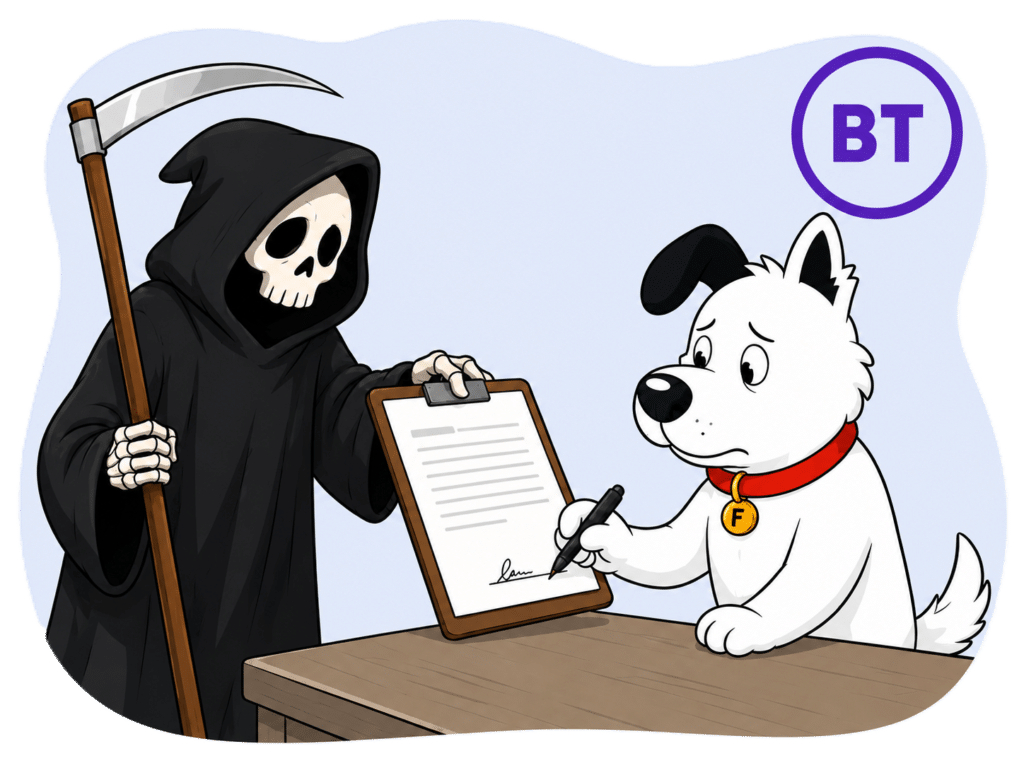
The fibredog mascot dog signing an BT Broadband contract held out by the grim reaper, denoting that signing without reading all BT Broadband contracts and small print terms can be risky
fibredog mascot wearing a headset

Having trouble choosing a broadband provider?

No single best provider or package exists – only the best pick for you personally. Fibredog’s YourMatch™ system uses thousands of provider metrics and a lot of maths to find you your perfect match.

BT Broadband contracts and small print scorecard

Six key areas. One overall score. All calculated using our transparent methodology.

Contract commitment

How restrictive the core contract is, including minimum terms, rolling options, notice periods and what happens when the deal ends.

7.3/10

Price rise terms

How clearly price increases are explained, including fixed annual rises, inflation clauses, timing and any terms that could change the bill.

5.0/10

Early-exit fees

How expensive it can be to leave early, including calculation methods, remaining-contract charges, caps and whether future rises are included.

7.6/10

Speed guarantees

How meaningful the speed promises are, including minimum guaranteed speeds, fault routes, cancellation rights and any service-code protection.

6.9/10

Equipment ownership

What happens to supplied equipment, including ownership, return deadlines, packaging, collection options and any non-return charges.

8.0/10

Hidden catches

How many awkward details sit in the small print, including unusual restrictions, extra obligations and terms that are easy to miss.

5.0/10

Contract commitment

Here, we’re going to examine BT’s minimum terms, what changes once yours finishes, how much notice you'll need to give, and which decisions could commit you to another contract.

Most BT Broadband contracts run for 24 months

BT offers primarily 24-month contracts across its current range, but that isn’t your only choice. You’ll also find 12-month versions you can tab across to on its sign-up page, although BT charges substantially more each month for them.

You can leave whenever you choose, but doing so during your minimum term will cost you, as you might expect. BT calculates the charge from what you’d have paid over the remaining months, minus the costs it saves because it no longer has to supply its services. Exceptions include certain unfixable faults, persistently low speeds, a serious breach of contract by BT itself, and a house move where it can’t supply your package at your new address.

Your BT Broadband carries on when the minimum term ends

Reaching your contract end date doesn’t mean being disconnected from BT. BT continues providing the service until you cancel it or switch away. You won’t suddenly lose your connection simply because the minimum term shown on your account has finished.

That's useful of course, but letting the contract drift isn’t necessarily cheap either. Promotions can expire, and BT says some services may cost more once your minimum term finishes. BT requires 30 days’ notice if you cancel directly, and if you choose to switch, it ends the agreement when the switch completes. Before either happens, BT will contact you to say that your contract is approaching its end.

Contract loop explained

The BT Broadband contract loop

You get the lowest price from a new contract. When it ends, BT Broadband increases the monthly price by around 13%, a noticeable end-of-contract rise.

Your choice point

Switch, haggle, recontract, or roll on at the standard monthly price.

New deal Best monthly price, but the clock is now ticking.
Locked in For 24 months, unless you switch to a provider with broadband buyout.
Term ends You should already have renegotiated or switched by now.
A noticeable rise The monthly rate rises by around 13% when the term ends, while annual increases can push it higher still.
Sign up or recontract Best value

During your first term, it's as cheap as it gets. Sometimes you can get close when negotiating a second term.

Switch or recontract Most flexible

Thanks to broadband buyout schemes, you can often switch up to six months before your contract ends.

Do nothing Not ideal

At the end of your contract you will roll onto a monthly rate around 13% higher, on top of any annual price rises already applied.

INTERACTIVE TOOL

When can I switch to a new provider?

See whether the provider you want to move to may cover your current broadband early exit fee.

Step 1: Which provider are you currently with?

Choose your current broadband provider.

Step 2: Which provider are you looking to move to?

Choose the provider you are thinking of switching to.

Step 3: How many months are left on your current contract with your current provider?

Enter the number of payments left, or tell us your minimum term has finished.

or

Step 4: How much are you paying per month?

Enter your current broadband monthly price.

£

Step 5: When can I switch to BT Broadband?

We calculate your current exit fee and compare it with the switching credit from the provider you want to move to.

Your switching result

    Where do you want to go next?

    BT lets you cancel whenever you like, but leaving during your minimum term will mean an early termination charge. You can escape without one in specific circumstances, including serious contractual failings by BT, certain broadband faults, persistently low speeds or a house move where BT can’t supply the service at your new UK address.

    Changing your BT service could start another minimum term

    Upgrading or changing your BT service can come with a new minimum term, although BT may instead carry across whatever remains of your existing one. It says in its terms and conditions that it’ll tell you which applies before the change is agreed. Recontracting or upgrading a linked landline or EE TV service can also automatically recontract your BT Broadband, so check every affected contract date before accepting an offer.

    joining mascot

    Most will choose BT's 24-month contract option, as it's far cheaper than 12 months. In either case, it'll roll on after the minimum term, at which point you can switch or recontract with BT. Changing or recontracting can start another minimum term, but there are useful no-fee exceptions for qualifying faults, persistently low speeds, serious failings by BT or a house move where BT cannot supply the new address. It's relatively flexible in the grand scheme, but certainly nothing to write home about.

    0.0 /10
    Overall score

    Contract commitment score

    This score looks at how much commitment you're taking on when you sign up, and whether you've got any realistic ways to choose a shorter or more flexible contract.

    Price rise terms

    Few people read a broadband contract before signing it, but pricing clauses are exactly why you should. The figure advertised today isn’t what you’ll pay throughout the entire minimum term, and other charges around your main broadband package can follow different rules entirely.

    BT makes its main price rises clear, then complicates everything else

    The advertised monthly price rises by £4 each year

    BT’s current broadband deals show the price increasing by £4 on 31 March each year. That means a new 24-month contract taken now can receive two separate rises before its minimum term finishes. A package starting at £27.99, for example, becomes £31.99 after the first rise and £35.99 after the second.

    We're not a fan of annual rises written into broadband contracts because they're above inflation for a lot of packages - meaning a lot of customers are now in a situation where they're paying for a little extra clarity. Hardly what Ofcom intended. But, BT does at least put the future prices alongside the starting price, so you can see the damage before signing up, rather than being asked to calculate it yourself.

    The £4 increase doesn’t cover every charge on your bill

    BT separates your core monthly charge from other charges and additional services. The core price rises by the stated annual amount, while certain other charges increase by a percentage instead. BT says both figures will appear in your order confirmation and tariff guide. Charges for additional services sit outside that automatic yearly formula and have their own rules. Delightful!


    If your broadband package comes with extras, phone services or other chargeable features, the reassuringly simple £4 figure doesn’t place your entire BT bill on the same predictable path. Check which parts of your order count as separate services and what their individual terms allow, especially if the combined monthly total matters more to you than the broadband price viewed on its own.

    BT gives itself other reasons to change what you pay

    The annual increase isn’t BT’s only route to higher charges. Its contract also permits changes when supplying the service becomes more expensive, its running costs rise, its business is reorganised or a relevant law, regulation or responsibility changes. It can also alter charges when it changes the service, its features, equipment or contractual terms.

    There is some protection here, though. If BT changes a core charge in a way that isn’t solely to your benefit, or another change significantly disadvantages you, it should normally give you at least 30 days’ notice and an opportunity to leave without an early termination charge. That protection doesn’t apply to the scheduled annual increase, and changes to one-off charges or additional services also won't hand you a get out of jail free card.

    Ofcom offices
    Ofcom Offices, London

    Where's Ofcom on all this?

    Ofcom has tightened the rules, but it hasn't made broadband contracts fully predictable.

    What Ofcom fixed

    The April rise now has to be shown upfront

    Since 17 January 2025, providers can't use unknown future inflation to calculate in-contract price rises. If a price rise is written into your contract, it has to be shown clearly in pounds and pence before you sign up.

    That's a real improvement. You should be able to see the planned April increases before you're locked into a deal.

    What's still loose

    It isn't a full ban on extra price movement

    Ofcom's rules are mainly about making agreed price rises clear, not freezing every possible charge for the whole contract.

    If a provider raises prices beyond what you agreed, Ofcom says you should get notice and the right to leave penalty-free. That's useful, but it still isn't the same as a simple fixed-price contract.

    Sources: Ofcom, Guardian

    When your BT Broadband bill can rise outside April

    The April rise is the headline one, but it isn't always the only route in the contract. These are the clauses that can push your bill up, plus the areas where you're less exposed.

    Most likely to matter

    Add-ons and extras aren't protected by the April promise

    You can still see add-ons, admin costs, paper billing, non-inclusive calls and other out-of-bundle charges change separately from the advertised April rise.

    Changing your package can change your bill straight away

    Adding, removing or reducing services can change what you pay outside the advertised April annual price rise.

    Fee clauses

    Cost-based fees can move when costs move

    BT Broadband can change what you pay for charges linked to providing a service or carrying out a task, separate from the April rise.

    Missed payments can add extra charges

    If you pay late, miss a payment or a payment fails, you can face interest, default charges or bank-related charges separately from the April price rise.

    Not returning kit can get expensive

    If you don't return equipment, you can face replacement, recovery or legal recovery charges outside the advertised April rise.

    Outside BT Broadband's control

    Law, tax and regulator changes can still hit your bill

    If law, VAT, tax, government, regulator or legal obligations change, you can see charges rise outside the advertised April rise.

    Some rates can follow wholesale costs

    If wholesale-linked rates change, such as international call rates, you can see those changes passed on separately from the advertised April rise.

    One-off life admin

    Moving home can bring a transfer fee

    If you move home and transfer the service, you might pay a home-move fee.

    Less likely to matter

    Third-party charge changes aren't stated separately

    BT Broadband doesn't state in its contract that third-party charge or term changes can raise your bill separately from the advertised April rise.

    Home moves aren't stated as starting a new minimum term

    BT Broadband doesn't state in its contract that moving home will start a new minimum term.

    Legal or regulatory changes can also push prices up

    BT can also change your charges in response to a new law, regulation, code of practice, official guidance or responsibility placed upon it. Its own example, from its terms and conditions, is an increase in VAT: if the tax rises, BT can pass that extra cost on to you.

    The wording is broader than tax alone, though, so the effect on your bill will depend on what has changed and which charge BT says it affects. It feels as though we're still a very long way from seeing truly fixed pricing, sadly.

    BT Broadband clearly states its main annual price rise and shows the future monthly prices upfront, which it's actually obligated to. In the contract itself, add-ons, separately charged services, package changes, late-payment or equipment charges, and changes linked to costs, tax, regulation or wholesale rates can still alter your bill outside the advertised rise. BT ticks every loophole, basically.

    0.0 /10
    Overall score

    Price rise terms score

    This score looks at how much protection you've got against extra price increases or added charges beyond the advertised April rise.

    Early exit fees

    BT’s 24-month contracts reward you for time served with their lowest price, but they also make changing your mind expensive. If you need to leave before the minimum term finishes, the eventual cost ultimately depends on how many months remain, what you pay and how much BT saves by no longer serving you.

    Key takeaways

    Cancelling your service doesn’t cancel your financial commitment

    BT lets you end your broadband contract at any point, but leaving during the minimum term will mean an early termination charge. If you cancel, you’ll also have to keep paying through a minimum notice period of up to 30 days. Switching ends your agreement when the switch completes instead.

    BT can also charge you if it terminates your contract itself because you’ve seriously broken the agreement. The reasons listed include non-payment, fraud, serious misuse, cancelling your Direct Debit without arranging another payment method and using your residential broadband to run a proper business. Either way, leaving the service early doesn’t automatically release you scot free.

    BT deducts its savings before presenting you with the bill

    BT starts with the discounted monthly amount you were committed to paying and multiplies it by the time remaining. It then removes VAT, deducts costs it expects to save because it doesn't need to provide you broadband, applies a further 1% reduction for receiving the money early and adds VAT to the result.

    That calculation is fairer than demanding every remaining payment in full (amazingly, there are still provider who will try to do that), but the saved-cost deduction isn’t a fixed percentage. BT’s own example turns £140 of remaining payments into a £67.32 exit fee – just under half the original amount (48%). Your fees could differ, so the only dependable rule is that leaving near the beginning of a 24-month contract will hurt much more than leaving near the end.

    You can leave for free, but only for an accepted reason

    BT won’t charge an early termination fee if you cancel during the cooling-off period, leave after a change that significantly disadvantages you, or because because BT has broken an important rule in the contract - contracts work both ways remember. Qualifying broadband faults, consistently low speeds and BT moving you to another service can also provide a free route out.

    Moving home has its own exception. If BT can’t provide your service exactly as it was at your old address, you can leave without paying the early termination charge. If it can, the contract simply carries on and that exception disappears. Wanting a different provider, finding a cheaper deal or simply no longer needing broadband won’t be enough for a clean escape.


    exiting mascot

    BT’s early exit fee isn’t simply your monthly price multiplied by the number of months left. It removes VAT, subtracts the costs saved by ending your service, applies a 1% reduction and then adds VAT back. BT doesn’t actually publish one fixed percentage, so you can’t calculate the exact charge from your bill alone. Not very helpful. In essence, though, the more time remaining on your contract, the more expensive leaving is likely to be.

    COMPARISON CHART

    How much of your remaining contract could BT Broadband charge?

    This chart compares the percentage of remaining contract charges providers may use when calculating early exit fees.

    Provider N/A Percentage of remaining charges used by this provider.
    Provider average N/A The average percentage among providers with early exit fee data in our database.
    Providers N/A providers currently have percentage-based early exit fee data in our database.

    Early exit fee percentage by provider

    Percentage of remaining charges

    Provider view

    The provider-average benchmark only includes providers where an early exit fee applies during the minimum term and a percentage of remaining charges is held in our database.

    INTERACTIVE TOOL

    How much will I pay to leave my broadband contract early?

    Select your current provider, choose your package, then tell us how long you have left and what you pay each month. We'll estimate what your provider may ask you to pay if you leave early.

    Step 1: Which provider are you currently with?

    Choose your current broadband provider.

    Step 2: Choose your package

    Pick the package you are currently on.

    Step 3: How many months have you got left?

    Enter the number of payments left, or tell us your minimum term has finished.

    or

    Step 4: How much are you paying per month?

    Enter your current broadband monthly price.

    £

    Step 5: How much might I pay to leave early?

    We calculate your estimated fee from your remaining months, monthly cost and your provider's early-exit rules.

    Your early exit fee estimate

      Where do you want to go next?

      What BT Broadband leaves out

      52%

      of the remaining charges are usually waived by BT Broadband

      Monthly escape cost

      £14.40

      for every £30 monthly payment still left on your contract

      Upper ceiling

      100%

      of the remaining contract value is the recorded maximum charge

      Future rises

      Left out

      BT Broadband doesn't record future price rises in the exit-fee calculation

      BT Broadband's early exit fee starts with the discounted monthly charges left on your contract, then removes VAT, deducts the costs BT saves and applies a further 1% reduction before VAT is added back. Bt's published example puts that at around 48% of the remaining contract value, though this will differ from package to package. There are fair free-exit routes for qualifying faults, persistently low speeds, serious failings, significant contract changes or a house move where BT cannot supply your new address.

      0.0 /10
      Overall score

      Early exit fee score

      This score looks at how much you may have to pay if you leave during your minimum term, and whether there are fair ways out when the service no longer works for you.

      fibredog mascot wearing a headset

      Having trouble choosing a broadband provider?

      No single best provider or package exists – only the best pick for you personally. Fibredog's YourMatch™ system uses thousands of provider metrics and a lot of maths to find you your perfect match.

      Speed guarantees

      Broadband speeds are advertised as averages, but your own line has to live in the real world. Distance, network conditions and the technology reaching your home all affect what BT can deliver, which is why the speed promised to you personally differs quite often from the one you see advertised.

      BT gives you a personal speed floor, not one generic percentage

      BT sets a personalised minimum speed when you join or renew. The contract calls this your ‘minimum guaranteed line access speed’, while your order confirmation contains the figure that actually applies to your home. That’s better than one percentage being used for every line regardless of its capabilities.

      Keep your order confirmation somewhere accessible, because the guarantee is difficult to use if you don’t know the promised number. BT may show speed information through its app and account tools, but the figure agreed when you ordered is the one you’ll need if the service later falls short.

      BT gets 30 days to restore your speed

      Once your service has been active for more than 10 days, BT’s contract lets you report speeds that regularly fall below its estimate. You’ll need to follow BT’s troubleshooting instructions and give it the opportunity to improve the connection rather than treating one poor test as an immediate route out, though.

      The BT Stay Fast Guarantee says if your speed isn’t restored within 30 days, you can leave without paying an early termination charge. The contract also protects your rights where your download speed continues to fall below your personalised minimum. And that's a proper contractual escape route, not just a small goodwill payment for poor performance.

      The guarantee covers the speed at the wall, not your Wi-Fi

      BT measures the speed reaching your BT Hub from the wall, not the speed travelling over Wi-Fi to your phone, laptop or television. That distinction is crucial. A fast connection can still feel slow because of thick walls, interference, poor device placement or an overcrowded home network, none of which proves BT has missed that guarantee.

      BT says you must use the BT Hub and BT’s own speed tester when making a claim. The test also checks for underlying faults, and BT can ask you to stop downloads and streaming before it measures the line. If further investigation is needed, you may also have to complete more checks and accept an engineer visit.

      You have to let BT investigate before you can leave

      The guarantee isn’t an automatic cancellation button whenever a speed test produces a disappointing result. BT requires the problem to be reported, tested and worked through properly. Its contract refers to speeds regularly falling below the minimum, which rules out treating one brief slowdown as a contractual failure.

      That’s a reasonable process, provided BT handles the fault properly and doesn’t keep resetting the clock. Record your test results, dates and conversations as you go. If the speed remains below the guarantee after the repair period, having a clear history will make it much easier to establish your right to leave without charge.

      COMPARISON CHART

      How does BT Broadband's minimum speed guarantee compare with other providers?

      This chart compares each provider's minimum speed guarantee as a percentage of its advertised download speed.

      Provider N/A Minimum guaranteed speed as a percentage of advertised download speed.
      Provider average N/A The average minimum-speed percentage among providers in our database.
      Providers N/A providers currently have minimum speed guarantee data in our database.

      Minimum speed guarantee by provider

      Percentage of advertised download speed

      Provider view

      The provider-average benchmark only includes providers with a minimum speed guarantee and an average percentage of advertised download speed in our database. Providers that do not offer a speed guarantee are included in the chart but are not included in the average.

      INTERACTIVE TOOL

      Which BT Broadband speed is right for me?

      Tell us about your household and we will tell you the exact best-fit broadband package from BT Broadband.

      Start here. Adjust the numbers, then calculate your result.

      Step 1: Tell us what is in your home

      Use the buttons below to tell us how many people and connected devices your household has.

      People
      0
      TVs
      0
      Consoles / gaming PCs
      0
      Non-gaming computers
      0
      Mobiles
      0
      Smart devices
      0

      Step 2: Calculate your best-fit package

      Once you are happy with the numbers above, press calculate and we will match your household to the closest BT Broadband package.

      Your result

      Recommended package Estimated need: Includes headroom
      Good fit

      This speed is ideal for:

        Where would you like to go next?

        How to use BT's Stay Fast Guarantee

        1. Find your guaranteed speed

          Check the Stay Fast Guarantee in your order confirmation. It is the minimum download speed BT promises to your BT Hub.

        2. Test and report the problem

          Use BT's speed tester or the My BT app with your BT Hub, then contact BT if the result falls below your guarantee.

        3. Complete BT's checks

          Carry out every check BT requests inside your home and allow at least one engineer visit.

        4. Give BT 30 days

          BT has up to 30 days to restore the guaranteed speed. The fault must be within BT's control and its tester must still show the shortfall.

        5. Leave without penalty

          If BT cannot fix it in time, you can end the affected phone, broadband and TV contracts without an early cancellation fee. BT Mobile is excluded.

        BT Broadband's personalised Stay Fast Guarantee protects around 63% of its advertised download speed on average. It's higher on some packages than others. If a fault within BT's control leaves the speed to your BT Hub below that guarantee, BT has 30 days to put it right after you report it and complete its checks, including an engineer visit. This is all perfectly reasonable.

        0.0 /10
        Overall score

        Speed guarantee score

        This score looks at how useful the provider's minimum speed guarantee is, how much speed it actually protects, and whether you can leave if the problem isn't fixed.

        Equipment ownership and returns

        Your BT router is included with the service, but it isn’t a free gift. BT retains ownership of its router, Wi-Fi extenders and any other loaned equipment, which means you’re responsible for looking after everything and returning it when it’s no longer required. Ignore that obligation and BT will add non-return charges to your account, so beware.

        How BT broadband equipment returns work

        Some BT equipment is loaned, not yours

        BT owns Hubs and TV boxes supplied to customers who joined or renewed from 13 December 2019. Complete Wi-Fi discs are also loaned.

        Equipment bought outright is yours, but paying a non-return charge for loaned kit does not transfer ownership to you.

        Return it when the service ends

        When your BT service or a relevant add-on ends, return every item of loaned equipment BT asks for.

        BT will email a QR code and printable label so you can return the parcel through Royal Mail without paying postage.

        Keep it in reasonable condition

        BT requires you to look after its equipment and not damage, destroy or interfere with it unless BT asks you to.

        If it is damaged beyond fair wear and tear, you may have to pay for its repair or replacement.

        Don't miss the 60-day deadline

        You have 60 days from the date you stop using the equipment to return it before BT charges you.

        The non-return charge varies according to the Hub, TV box, Wi-Fi disc or other loaned device you have.

        You can still get the full charge back

        A non-return charge does not transfer ownership of BT loaned equipment to you.

        Return the equipment within two years of being charged and BT will credit the full amount. If the account is closed, BT says it will send a cheque to your last known address.

        Do not treat BT loaned equipment as yours. Return every loaned item BT requests within 60 days, keep it in reasonable condition and retain your proof of postage.

        BT’s loaned equipment never becomes yours

        BT’s contract is unambiguous about ownership. Your router and any other loaned equipment belong to BT throughout the agreement. Paying a non-return charge doesn’t buy the equipment or transfer ownership to you, so you can’t simply settle the bill and move to South America with your new-found fortune.

        You’re expected to protect it from loss and damage, and you mustn’t destroy, dispose of or interfere with it unless BT asks you to. Damage beyond reasonable wear and tear can leave you paying for repair or replacement as well as returning what remains.

        BT provides a free and straightforward return route

        When BT needs its equipment back, it’ll email you a QR code and printable returns label. Package everything securely, then take it to a Royal Mail Customer Service Point, usually found at a delivery office like a local newsagent or mini-market, or a Post Office branch. You can use the box supplied with replacement equipment or suitable packaging of your own.

        The return itself is free. If everything won’t fit into one parcel, BT lets you request another label. Don’t take broadband equipment to an EE store, though. BT’s current guidance says EE's stores accept mobile phone returns only.

        You get 60 days before BT charges you

        BT gives you 60 days from the end of your contract to return equipment. That includes the router and any BT Complete Wi-Fi devices supplied with your package. BT says it’ll tell you what needs returning, and the same information should appear under ‘Return equipment’ in My BT.

        Miss the deadline and BT will charge you for each outstanding item. You haven’t necessarily lost the money forever, though. If you return the equipment within two years, BT says it’ll refund the full charge. Keep your Royal Mail receipt and tracking details until the return has appeared on your account, just to be safe.

        post office dog

        BT Broadband is unusually clear about which equipment remains on loan, gives you a reasonable 60-day return window and provides a free Royal Mail route using a QR code or printable label. Its non-return charges are published and can be substantial when several devices are outstanding, but returning the equipment within two years gets the full charge credited back, which is notably forgiving.

        0.0 /10
        Overall score

        Equipment returns score

        This score looks at how clear the provider is about borrowed equipment, how easy it makes returns, and how much fee risk sits around missing, lost or damaged kit.

        Restrictions, penalties and hidden catches

        BT’s broadband contract spreads the important restrictions across several sections (yes, we had to read it all), then sends you elsewhere for the actual charges. None of that makes it unusually harsh, but it does make the real agreement much larger than the package price and contract length displayed when you sign up.

        The smaller charges are scattered across BT’s paperwork

        Your monthly broadband payment isn’t the only amount BT can add to your bill. Paper statements can cost extra, while late and failed payments have separate charges. BT can also recover debt-collection costs, charge for engineer visits and bill you when an appointment is missed or its engineer can’t enter the property.

        Changing or upgrading the service can produce an activation charge or a new minimum term. If BT supplies replacement equipment and you don’t return your old device(s), it can restrict your service or recover its costs. Individually, these are ordinary contractual charges. Together, they’re why BT’s headline monthly price never tells you the whole story.

        Installation depends on access, permission and a workable property

        You’re responsible for obtaining any permission BT needs to install the service, including approval from a landlord or anyone else whose property is affected. An adult who can decide where equipment should go must be present, and BT may need temporary access to disconnect or alter your existing line.

        Installation costs can change if a survey finds that extra construction work is required. You also need to rearrange appointments with enough notice and make sure the engineer can get in. BT’s responsibility largely stops with its own equipment. Reconnecting televisions, consoles and other devices is left to you unless you want to pay for a Home Tech Expert visit.

        Home broadband is for your household, not for your business

        BT supplies its residential service for personal use by you and your household. Using it for a trade, business or profession breaks the agreement and can lead to restriction or cancellation. That won't include things like simple emailing and office work done from home, though. You’re also responsible for how anyone else in the home uses the connection.

        Your contract permits monthly usage limits, even though BT’s current broadband packages include unlimited data. It also lets BT manage network performance in exceptional circumstances and take network-level action when it believes one of your devices contains malware or is trying to reach a malicious website.

        BT keeps extensive control over the service after you join

        BT can update or replace loaned equipment, alter its software automatically and change features, technical specifications or the way the service works. It can withdraw a service altogether and move you to what it considers the next-best or better alternative, although certain disadvantageous changes do give you the right to leave.

        Your responsibilities also continue beyond simply paying the bill. You must follow reasonable instructions, protect your account details, read the notices BT sends and disconnect anything that could harm its network. BT provides the connection, but the contract leaves it firmly in control of the equipment and the rules surrounding its use.

        AT A GLANCE

        Everything hidden in your BT Broadband contract you need to care about

        A quick view of the charges, restrictions, provider powers and installation catches that can sit quietly in the small print.

        Rule
        Status
        Impact
        Extra charges
        Paper billing charge
        Yes
        Not ideal
        Non-Direct Debit payment charge
        Yes
        Not ideal
        Late payment charge
        Yes
        Not ideal
        Failed payment charge
        Yes
        Not ideal
        Service change fee possible
        Yes
        Not ideal
        Technician charge if fault is yours
        Yes
        Worth knowing
        Technician charge for missed appointment
        Yes
        Not ideal
        Usage rules
        Residential use only
        Yes
        Worth knowing
        Business use restricted
        Yes
        Worth knowing
        Acceptable use policy applies
        Yes
        Worth knowing
        Service suspension for misuse
        Yes
        Not ideal
        Traffic management or monitoring right
        Yes
        Worth knowing
        Data usage allowance possible
        Yes
        Not ideal
        Provider powers
        Can change equipment or services
        Yes
        Not ideal
        Can withdraw package and move you
        Yes
        Not ideal
        Third-party charges are your responsibility
        Yes
        Not ideal
        Installation catches
        You handle installation permissions
        Yes
        Worth knowing
        Installation subject to survey
        Yes
        Worth knowing
        Can refuse installation for credit policy
        Yes
        Worth knowing
        Can refuse installation for device compatibility
        No
        Good for you
        After cancellation and router extras
        Provider email lost after cancellation
        Yes
        Not ideal
        Public Wi-Fi hotspot can be enabled
        Yes
        Worth knowing

        How to avoid tripping up on your BT Broadband contract

        1. Keep payments predictable

          Keep your agreed payment method active, pay bills on time and remember that BT may charge if you request paper broadband bills.

        2. Ask before changing anything

          Before you upgrade or accept an offer, check the new monthly charge, any activation or installation fee and whether a new minimum term applies.

        3. Make installation easy

          Get any required permissions, make sure an adult is present and give BT at least two working days' notice if you change or cancel the appointment.

        4. Use it like home broadband

          BT home broadband is for you and your household, not for running a trade, business or profession.

        5. Keep notices visible

          BT can send notices through your equipment, by email or post, and may also use voicemail or text. Keep your contact details current and read what it sends.

        BT Broadband's contract contains a dizzying collection of potential extra charges, usage restrictions and provider powers beyond the headline monthly price. Paper billing, alternative payment methods, late or failed payments, missed appointments, customer-caused engineer visit problems and service changes can all cost more, while BT keeps considerable control over equipment, software, packages and linked services.

        0.0 /10
        Overall score

        Hidden contract catches score

        This score looks at how much cost, friction and provider control is tucked into the contract beyond the headline monthly price.

        fibredog mascot wearing a headset

        Having trouble choosing a broadband provider?

        No single best provider or package exists – only the best pick for you personally. Fibredog's YourMatch™ system uses thousands of provider metrics and a lot of maths to find you your perfect match.

        Some links on this page may earn us a small commission if you click through and buy. This never affects either what you pay, or our scores and recommendations. If, however, you’d rather bypass affiliate links, use this direct BT Broadband link instead.