
VODAFONE BROADBAND CONTRACTS AND SMALL PRINT REVIEW

Vodafone Broadband contracts and small print: How friendly are they?

Vodafone Broadband is a great provider on the surface, but most providers hide the nasty bits in their contracts? Are there any nasties lurking here? For that, we’ll need to take a comprehensive look.

By Data checked  Checked weekly
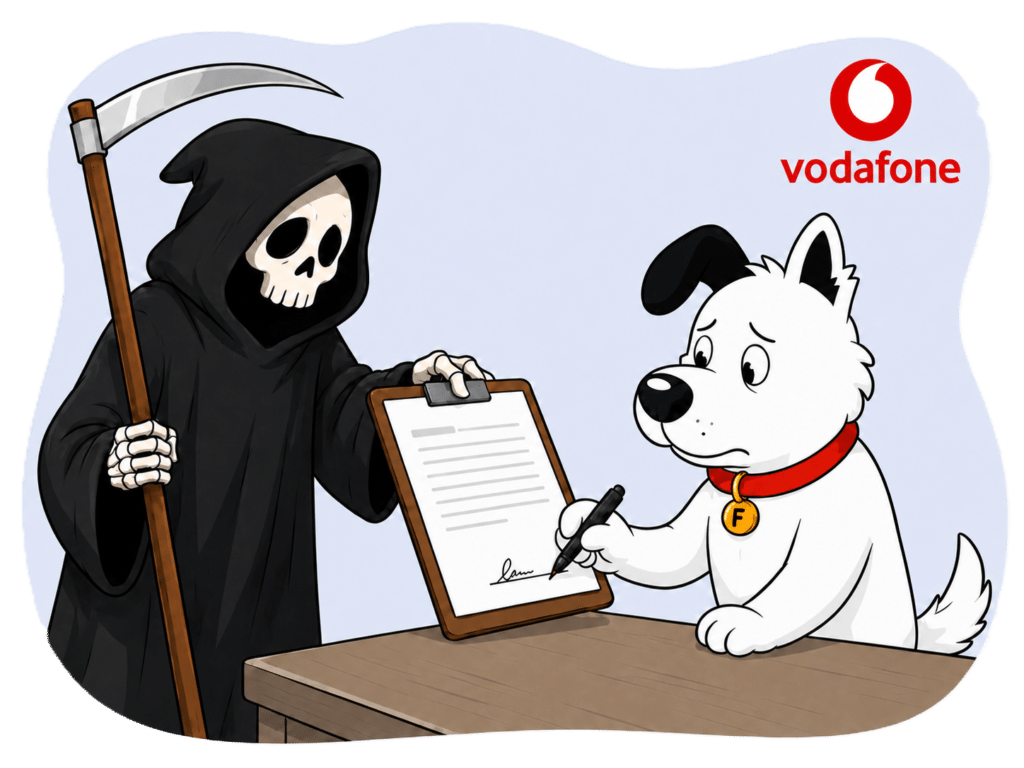
The fibredog mascot dog signing an Vodafone Broadband contract held out by the grim reaper, denoting that signing without reading all Vodafone Broadband contracts and small print terms can be risky
fibredog mascot wearing a headset

Having trouble choosing a broadband provider?

No single best provider or package exists – only the best pick for you personally. Fibredog’s YourMatch™ system uses thousands of provider metrics and a lot of maths to find you your perfect match.

Vodafone Broadband contracts and small print scorecard

Six key areas. One overall score. All calculated using our transparent methodology.

Contract commitment

How restrictive the core contract is, including minimum terms, rolling options, notice periods and what happens when the deal ends.

6.7/10

Price rise terms

How clearly price increases are explained, including fixed annual rises, inflation clauses, timing and any terms that could change the bill.

5.2/10

Early-exit fees

How expensive it can be to leave early, including calculation methods, remaining-contract charges, caps and whether future rises are included.

4.3/10

Speed guarantees

How meaningful the speed promises are, including minimum guaranteed speeds, fault routes, cancellation rights and any service-code protection.

7.3/10

Equipment ownership

What happens to supplied equipment, including ownership, return deadlines, packaging, collection options and any non-return charges.

10/10

Hidden catches

How many awkward details sit in the small print, including unusual restrictions, extra obligations and terms that are easy to miss.

6.9/10

Contract commitment

Vodafone’s Full Fibre packages tie you in for 24 months, but it does at least offer genuine 12-month contracts on its two slowest tiers. There’s no rolling monthly choice for new sign-ups, and changing package can restart the clock. Once your minimum term ends, your service continues until you cancel.

Most packages still mean a two-year commitment

Vodafone’s mainstream Full Fibre range comes with a 24-month minimum term. There’s no rolling monthly package for new sign-ups, so most people must either accept two years or look elsewhere. That’s a long commitment when prices, providers and your own circumstances can all change considerably in that time.

Unusually, Vodafone also offers genuine 12-month contracts to everyone, rather than reserving them for social-tariff users. The choice is limited to its two slowest Full Fibre tiers and costs considerably more each month, but it’s still a useful escape from the usual two-year lock-in.

Your contract ends, but your broadband continues

Reaching the end of your minimum term doesn’t cancel the service. Vodafone moves you onto a rolling monthly arrangement until you leave or accept another deal, with 30 days’ notice required if you decide to go. That’s standard enough, but there’s no rolling option when you first join.

Your introductory discount also ends, so ignoring Vodafone’s end-of-contract notification can leave you paying considerably more. You can recontract online without making a phone call, but keeping a discounted price means accepting another minimum term. Vodafone gives you a choice at the finish line, just not an especially attractive one.

Contract loop explained

The Vodafone Broadband contract loop

You get the lowest price from a new contract. When it ends, you can expect a sizeable increase of around 22% in the monthly price.

Your choice point

Switch, haggle, recontract, or roll on at the standard monthly price.

New deal Best monthly price, but the clock is now ticking.
Locked in For 24 months, unless you switch to a provider with broadband buyout.
Term ends You should already have renegotiated or switched by now.
A sizeable rise The monthly rate rises by around 22% when the term ends, making rolling on much less competitive.
Sign up or recontract Best value

During your first term, it's as cheap as it gets. Sometimes you can get close when negotiating a second term.

Switch or recontract Most flexible

Thanks to broadband buyout schemes, you can often switch up to six months before your contract ends.

Do nothing Not ideal

At the end of your contract you will roll onto a monthly rate around 22% higher, on top of any annual price rises already applied.

INTERACTIVE TOOL

When can I switch to a new provider?

See whether the provider you want to move to may cover your current broadband early exit fee.

Step 1: Which provider are you currently with?

Choose your current broadband provider.

Step 2: Which provider are you looking to move to?

Choose the provider you are thinking of switching to.

Step 3: How many months are left on your current contract with your current provider?

Enter the number of payments left, or tell us your minimum term has finished.

or

Step 4: How much are you paying per month?

Enter your current broadband monthly price.

£

Step 5: When can I switch to Vodafone Broadband?

We calculate your current exit fee and compare it with the switching credit from the provider you want to move to.

Your switching result

    Where do you want to go next?

    Vodafone gives you some genuine ways out, including 12-month packages and penalty-free cancellation when certain speed or Wi-Fi promises fail. Moving home is much harsher. Vodafone reserves the right to charge an early termination fee even when it can’t provide a suitable service at your new address.

    Changing package can restart the contract

    Vodafone lets you move both up and down its package range during your minimum term, and you can request the change online. An ordinary Full Fibre speed change can happen almost immediately, which sounds wonderfully flexible until you read what Vodafone treats that change as contractually.

    Your new package becomes a replacement agreement with a fresh minimum term, and Vodafone may also charge an early termination fee against the package being replaced. Restarting the clock is restrictive enough. Potentially charging you for changing between Vodafone’s own packages makes that apparent flexibility look rather less generous.

    joining mascot

    Vodafone’s 12-month contracts are a welcome rarity, although they’re limited and expensive beside its mainstream 24-month range. Your service rolls on after the minimum term, but discounts end and recontracting restarts the clock. Package changes can do the same, while moving home may leave you facing an early termination charge.

    0.0 /10
    Overall score

    Contract commitment score

    This score looks at how much commitment you're taking on when you sign up, and whether you've got any realistic ways to choose a shorter or more flexible contract.

    Price rise terms

    Vodafone tells you exactly how much the price of your broadband package will rise each April, which is far better than an inflation-linked guessing game. It isn’t fixed pricing, though. Other charges can rise separately, Vodafone retains broad powers to change what you pay, and your introductory discount ends with your minimum term.

    The annual increase is clear, but the wider terms aren’t

    Your broadband price rises by £3.50 every April

    Vodafone increases the monthly price of your broadband package by £3.50 every 1 April. The amount is written into the contract before you join, so you can work out each scheduled increase without waiting to see what happens to inflation. That level of clarity is welcome.

    The rise still applies during your minimum term, and you can’t leave without an early termination fee simply because it takes effect. Vodafone Essentials is exempt, but ordinary Full Fibre packages aren’t. Clearer pricing makes the increase predictable, not optional.

    Extras and other charges follow different rules

    The fixed £3.50 increase applies to your main broadband package, not everything Vodafone might add to your bill. Out-of-bundle charges rise each April by inflation plus 3.9%, while charges for extras can also increase separately.

    Vodafone promises at least 30 days’ notice before changing those extra charges, but that still leaves several parts of the bill moving under different rules. The headline annual increase is refreshingly simple. The complete picture is considerably less tidy.

    Vodafone keeps broad powers to change your bill

    Vodafone’s contract allows it to change its services, equipment and charges for an extensive list of reasons. These include altering how a service is supplied, changing its structure, increasing optional charges and responding to legal, regulatory or operating changes. It even reserves the right to make changes for reasons not specifically listed.

    You can leave without an early termination fee if a change harms your service and falls outside Vodafone’s permitted changes. Vodafone decides whether that test is met, however, and the scheduled April increase is expressly excluded. The protection is useful, but it’s nowhere near the certainty of a genuinely fixed-price contract.

    Ofcom offices
    Ofcom Offices, London

    Where's Ofcom on all this?

    Ofcom has tightened the rules, but it hasn't made broadband contracts fully predictable.

    What Ofcom fixed

    The April rise now has to be shown upfront

    Since 17 January 2025, providers can't use unknown future inflation to calculate in-contract price rises. If a price rise is written into your contract, it has to be shown clearly in pounds and pence before you sign up.

    That's a real improvement. You should be able to see the planned April increases before you're locked into a deal.

    What's still loose

    It isn't a full ban on extra price movement

    Ofcom's rules are mainly about making agreed price rises clear, not freezing every possible charge for the whole contract.

    If a provider raises prices beyond what you agreed, Ofcom says you should get notice and the right to leave penalty-free. That's useful, but it still isn't the same as a simple fixed-price contract.

    Sources: Ofcom, Guardian

    price rise mascot 1

    When your Vodafone Broadband bill can rise outside April

    The April rise is the headline one, but it isn't always the only route in the contract. These are the clauses that can push your bill up, plus the areas where you're less exposed.

    Most likely to matter

    Add-ons and extras aren't protected by the April promise

    You can still see add-ons, admin costs, paper billing, non-inclusive calls and other out-of-bundle charges change separately from the advertised April rise.

    Changing your package can change your bill straight away

    Adding, removing or reducing services can change what you pay outside the advertised April annual price rise.

    Fee clauses

    Cost-based fees can move when costs move

    Vodafone Broadband can change what you pay for charges linked to providing a service or carrying out a task, separate from the April rise.

    Missed payments can add extra charges

    If you pay late, miss a payment or a payment fails, you can face interest, default charges or bank-related charges separately from the April price rise.

    Not returning kit can get expensive

    If you don't return equipment, you can face replacement, recovery or legal recovery charges outside the advertised April rise.

    Outside Vodafone Broadband's control

    Law, tax and regulator changes can still hit your bill

    If law, VAT, tax, government, regulator or legal obligations change, you can see charges rise outside the advertised April rise.

    Some rates can follow wholesale costs

    If wholesale-linked rates change, such as international call rates, you can see those changes passed on separately from the advertised April rise.

    One-off life admin

    Moving home can bring a transfer fee

    If you move home and transfer the service, you might pay a home-move fee.

    Moving home can start a new minimum term

    If you move home, you might start a new minimum contract term, which matters if you're close to being free to switch.

    Less likely to matter

    Third-party charge changes aren't stated separately

    Vodafone Broadband doesn't state in its contract that third-party charge or term changes can raise your bill separately from the advertised April rise.

    An unplanned increase can give you the right to leave

    Vodafone draws the line between price changes written into your contract and changes introduced later. The £3.50 April increase forms part of the deal you accepted when joining, so you can’t leave without an early termination fee simply because it has taken effect.

    If Vodafone makes another change that negatively affects your service and falls outside its broad list of permitted changes, you have 30 days to leave without paying an early termination fee. Vodafone decides whether the change has a negative impact, however. Changes required by law and those with no meaningful effect on you don’t qualify either.

    Vodafone’s fixed £3.50 April increase is easy to understand and far more predictable than an inflation-linked formula. Unfortunately, that simplicity doesn’t extend across the whole bill. Extras and other charges follow separate rules, broad change clauses remain, promotional discounts expire, and the scheduled annual rise doesn’t give you a penalty-free way out.

    0.0 /10
    Overall score

    Price rise terms score

    This score looks at how much protection you've got against extra price increases or added charges beyond the advertised April rise.

    Early exit fees

    Vodafone’s early termination charge is punishing. Leave during your minimum term and it takes 80% of every remaining monthly payment, after discounts, for broadband you’ll no longer receive. Future annual increases aren’t included and the total can’t exceed the remaining contract value, but those are small comforts when the starting percentage is so high.

    Key takeaways

    Leaving early doesn’t make the contract disappear

    Cancelling while you’re still within your minimum term normally triggers Vodafone’s early termination charge. Switching through One Touch Switch doesn’t avoid it either. Your new provider can arrange the move, but you’ll still owe Vodafone whatever your contract says is due.

    Vodafone uses your discounted monthly price, takes 80% of it and multiplies that figure by the number of months remaining. The calculation is clear and future annual increases aren’t added, but clarity doesn’t make the result any less expensive.

    Vodafone charges four-fifths of what you had left

    Vodafone leaves you paying 80% of the remaining discounted value of your contract. Cancel with a year left and the charge is equivalent to roughly 9.6 monthly payments, despite Vodafone no longer providing your broadband. That is exceptionally harsh.

    Your existing discount does at least reduce the calculation, and Vodafone doesn’t include future April price rises. The charge is also capped at what you would otherwise have paid, so it can’t somehow grow beyond the remaining value of the agreement.

    Those protections prevent the calculation becoming even worse, but they don’t make it fair. Vodafone keeps four-fifths of the remaining income while no longer having to supply the service. You receive only a 20% saving for cancelling broadband you won’t use.

    Penalty-free exits exist, but they’re tightly drawn

    Vodafone won’t always charge you for leaving. You have 14 days after activation to change your mind, while certain serious service failures and detrimental contract changes can also give you a penalty-free exit. Pro 3’s Super WiFi guarantee provides another route if Vodafone can’t deliver 10Mbps in every room after supplying up to three boosters.

    Moving home offers far less protection. Vodafone reserves the right to apply an early termination charge when it can’t provide broadband at your new UK address. Being charged because Vodafone can’t follow you is particularly difficult to defend.


    exiting mascot

    Vodafone’s early termination formula is clear, capped and based on your discounted price. It’s also extremely expensive. Charging 80% of every remaining payment leaves you paying most of the contract for broadband you no longer receive, and even moving somewhere Vodafone can’t serve doesn’t guarantee that the fee will be waived.

    COMPARISON CHART

    How much of your remaining contract could Vodafone charge?

    This chart compares the percentage of remaining contract charges providers may use when calculating early exit fees.

    Provider N/A Percentage of remaining charges used by this provider.
    Provider average N/A The average percentage among providers with early exit fee data in our database.
    Providers N/A providers currently have percentage-based early exit fee data in our database.

    Early exit fee percentage by provider

    Percentage of remaining charges

    Provider view

    The provider-average benchmark only includes providers where an early exit fee applies during the minimum term and a percentage of remaining charges is held in our database.

    INTERACTIVE TOOL

    How much will I pay to leave my broadband contract early?

    Select your current provider, choose your package, then tell us how long you have left and what you pay each month. We'll estimate what your provider may ask you to pay if you leave early.

    Step 1: Which provider are you currently with?

    Choose your current broadband provider.

    Step 2: Choose your package

    Pick the package you are currently on.

    Step 3: How many months have you got left?

    Enter the number of payments left, or tell us your minimum term has finished.

    or

    Step 4: How much are you paying per month?

    Enter your current broadband monthly price.

    £

    Step 5: How much might I pay to leave early?

    We calculate your estimated fee from your remaining months, monthly cost and your provider's early-exit rules.

    Your early exit fee estimate

      Where do you want to go next?

      What Vodafone Broadband leaves out

      20%

      of the remaining charges are usually waived by Vodafone Broadband

      Monthly escape cost

      £24

      for every £30 monthly payment still left on your contract

      Upper ceiling

      100%

      of the remaining contract value is the recorded maximum charge

      Future rises

      Left out

      Vodafone Broadband doesn't record future price rises in the exit-fee calculation

      Vodafone’s 80% early termination charge is one of the nastiest parts of its contract. Discounts are recognised, future price rises are excluded and some penalty-free exits exist, but you still pay four-fifths of the remaining value for a service you won’t receive. Its refusal to guarantee a waiver when it can’t serve your new home makes matters worse.

      0.0 /10
      Overall score

      Early exit fee score

      This score looks at how much you may have to pay if you leave during your minimum term, and whether there are fair ways out when the service no longer works for you.

      fibredog mascot wearing a headset

      Having trouble choosing a broadband provider?

      No single best provider or package exists – only the best pick for you personally. Fibredog's YourMatch™ system uses thousands of provider metrics and a lot of maths to find you your perfect match.

      Speed guarantees

      Vodafone gives you a personalised minimum download speed before you join, rather than asking you to rely on the headline average. Its separate Super WiFi guarantee also promises at least 10Mbps in every room. The protections are useful, but Vodafone’s Full Fibre terms leave an awkward gap around how long it gets to fix a slow connection.

      Your minimum speed is confirmed before you join

      Vodafone gives you a personalised minimum download speed in your Service Confirmation Letter. It’s based on the package and connection available at your address, making it far more useful than the average speed used in advertising.

      Across Vodafone’s Full Fibre range, that minimum is typically around half the advertised download speed. That isn’t especially ambitious, but it does give you a clear floor against which to judge the connection Vodafone actually supplies.

      The Full Fibre fix process isn’t clear enough

      Vodafone’s terms say you can report a connection that repeatedly falls significantly below its minimum speed. If Vodafone can’t resolve the problem, it may move you to a slower package or let you leave without an early termination fee.

      Unfortunately, the same wording expressly excludes Vodafone Fibre to the Home, and Vodafone doesn’t publish a clear Full Fibre repair period elsewhere in its current terms. A speed guarantee loses quite a lot of value when the deadline and remedy are left this muddled.

      Super WiFi promises 10Mbps in every room

      Vodafone’s Super WiFi guarantee promises at least 10Mbps in every room, not merely at the router. That makes it genuinely useful in homes where the broadband line is fast enough but walls, distance or interference leave one room struggling.

      Super WiFi is included with Pro 3 and costs extra on ordinary packages, so this protection isn’t standard across the range. The 10Mbps target is modest beside modern Full Fibre speeds, but it’s still a meaningful promise where coverage matters more than outright pace.

      Vodafone gets three boosters and a chance to fix it

      Vodafone can supply up to three boosters when Super WiFi fails to deliver 10Mbps in every room. You must work through its attempts to diagnose and fix the problem, which is reasonable before a penalty-free cancellation right becomes available.

      If the guarantee still isn’t met after the third booster and Vodafone’s efforts to put things right, you can leave without an early termination fee. You must notify Vodafone within 30 days of receiving that third booster, though, so don’t let the deadline drift past.

      COMPARISON CHART

      How does Vodafone's minimum speed guarantee compare with other providers?

      This chart compares each provider's minimum speed guarantee as a percentage of its advertised download speed.

      Provider N/A Minimum guaranteed speed as a percentage of advertised download speed.
      Provider average N/A The average minimum-speed percentage among providers in our database.
      Providers N/A providers currently have minimum speed guarantee data in our database.

      Minimum speed guarantee by provider

      Percentage of advertised download speed

      Provider view

      The provider-average benchmark only includes providers with a minimum speed guarantee and an average percentage of advertised download speed in our database. Providers that do not offer a speed guarantee are included in the chart but are not included in the average.

      INTERACTIVE TOOL

      Which Vodafone Broadband speed is right for me?

      Tell us about your household and we will tell you the exact best-fit broadband package from Vodafone Broadband.

      Start here. Adjust the numbers, then calculate your result.

      Step 1: Tell us what is in your home

      Use the buttons below to tell us how many people and connected devices your household has.

      People
      0
      TVs
      0
      Consoles / gaming PCs
      0
      Non-gaming computers
      0
      Mobiles
      0
      Smart devices
      0

      Step 2: Calculate your best-fit package

      Once you are happy with the numbers above, press calculate and we will match your household to the closest Vodafone Broadband package.

      Your result

      Recommended package Estimated need: Includes headroom
      Good fit

      This speed is ideal for:

        Where would you like to go next?

        How Vodafone's minimum speed process works

        1. Find your guaranteed speed

          Find the personalised minimum speed in your Service Confirmation Letter. That address-specific figure matters more than the package's headline average.

        2. Check and report the problem

          Contact Vodafone if the qualifying sync speed continuously or regularly falls significantly below that minimum. Keep a note of your tests and when the problem began.

        3. Let Vodafone investigate

          Work through Vodafone's troubleshooting and allow any line tests, replacement equipment or engineer work it reasonably needs to try.

        4. Check which terms cover you

          Vodafone's current terms do not set out a clear numbered Full Fibre repair window, and the main minimum-speed remedy expressly excludes Fibre to the Home.

        5. Ask about your options

          Where the contractual remedy applies and Vodafone cannot fix the problem, you may move to a slower product or leave without an early termination fee.

        Vodafone’s personalised minimum speed and 10Mbps whole-home Wi-Fi promise provide useful protection, with up to three boosters and a penalty-free exit if Super WiFi still fails. The weak point is its Full Fibre wording, which doesn’t clearly state how long Vodafone gets to fix a slow connection or provide a clean contractual remedy.

        0.0 /10
        Overall score

        Speed guarantee score

        This score looks at how useful the provider's minimum speed guarantee is, how much speed it actually protects, and whether you can leave if the problem isn't fixed.

        Equipment ownership and returns

        Vodafone gives you ownership of its router just 14 days after activation. From that point, it’s yours to keep when you leave or upgrade, with no return deadline, missing-equipment charge or damaged-router bill hanging over you. Only cancellations before activation or during the cooling-off period require the equipment to go back.

        How Vodafone broadband equipment returns work

        The router normally becomes yours

        Vodafone's broadband router normally becomes your property 14 days after the service is activated.

        The installed Openreach or CityFibre ONT is separate infrastructure and does not become yours.

        There is usually nothing to return

        Once you own the router, Vodafone does not normally demand it back when your broadband ends or is upgraded.

        That makes ordinary end-of-contract returns refreshingly simple.

        Cooling-off cancellations are different

        If you cancel before activation or during the 14-day cooling-off period, ownership has not transferred.

        In that narrow situation, Vodafone expects the broadband equipment back.

        Return cooling-off kit within 30 days

        Equipment covered by that early-cancellation exception must be returned within 30 days.

        Vodafone publishes a £99 charge where the broadband router is not returned or comes back damaged.

        Recycle an old router for free

        You can voluntarily give an old Vodafone router back for free recycling, either in store or by post.

        That is an optional recycling service, not a normal contractual return requirement.

        Vodafone's usual rule is unusually generous. Once 14 days have passed after activation, the broadband router is normally yours and does not need returning when you leave.

        Your Vodafone router becomes yours after 14 days

        Vodafone transfers ownership of the supplied router to you automatically 14 days after your service is activated. You don’t have to buy it separately, complete another form or remain with Vodafone until the end of your minimum term. It simply becomes yours.

        The small fibre box installed in your home remains the network operator’s property, but that isn’t the router. Vodafone’s ownership terms are unusually generous and refreshingly clear, with none of the indefinite loan arrangement used by many large providers.

        Leaving Vodafone doesn’t create a returns chore

        Once the router belongs to you, Vodafone doesn’t require it back when you cancel, upgrade or replace your package. There’s no return deadline to remember, no packaging to wait for and no non-return fee capable of appearing weeks after you thought everything was settled.

        You can keep the router, store it as a spare or recycle it. Vodafone accepts old equipment voluntarily in store or by post, but that’s your choice rather than a contractual obligation. Giving you ownership is cleaner and considerably more consumer-friendly than organising an elaborate free return for equipment that was never yours.

        Cooling-off cancellations are the one exception

        Cancel before activation or within the 14-day cooling-off period and ownership hasn’t transferred, so the router must go back. Vodafone gives you 30 days after cancellation to return it and tells you how to do that.

        Fail to return the router within those 30 days, or send it back damaged, and Vodafone publishes a £99 charge. That’s substantial, but it applies only during this narrow opening period. Once the first 14 days have passed, the router is yours and the return rules disappear.

        post office dog

        Vodafone gets equipment ownership exactly right. Your router becomes yours 14 days after activation, with no return required when you leave or upgrade and no ordinary non-return or damage charges. Cooling-off cancellations carry a 30-day return deadline, but after that brief exception there’s no returns process to worry about at all.

        0.0 /10
        Overall score

        Equipment returns score

        This score looks at how clear the provider is about borrowed equipment, how easy it makes returns, and how much fee risk sits around missing, lost or damaged kit.

        Restrictions, penalties and hidden catches

        Vodafone’s small print contains plenty beyond the price of your broadband package. Extra charges, residential-use rules, installation conditions and broad powers to change the service all sit in the contract. Most are fairly standard, but missed appointments, faults inside your home and an installation Vodafone decides is too expensive can all cause trouble.

        Small charges can quickly make the monthly price irrelevant

        Vodafone can charge for paper billing, late payment, amending an order and cancelling an engineer visit too close to the appointment. Miss the visit entirely and the charge becomes much harder to shrug off. None of these is unusual, but there are enough of them to reward careful diary management.

        You can also be billed when an engineer discovers that the fault sits inside your home or was caused by your equipment. Vodafone publishes an initial investigation charge followed by further hourly costs, so calling an engineer before checking your own cables and devices can become an expensive shortcut.

        Passing the address check doesn’t guarantee installation

        Vodafone doesn’t finally commit to providing broadband until it has completed its feasibility checks. It can refuse or cancel the installation when the work would be excessively costly, even if its initial address checker suggested that the service was available.

        You’re responsible for obtaining permission from your landlord or property owner, along with any wayleave Vodafone needs to complete the work. That’s unavoidable when someone else owns the building, but it means an apparently straightforward order can still be delayed or stopped after you’ve signed up.

        Vodafone Broadband is for your home, not your business

        Vodafone sells its residential broadband for private, non-commercial use. Ordinary home working won’t suddenly turn you into a business account, but running business-critical systems, reselling the connection or using it as a commercial service would put you outside the agreement.

        Everyone using your connection must also follow Vodafone’s Acceptable Use Policy. Vodafone can monitor and manage traffic, suspend the service for misuse and act where activity risks harming its network. Those are broad powers, although they’re unlikely to trouble an ordinary household using broadband normally..

        Vodafone keeps plenty of control after you join

        Vodafone can change equipment, alter how the service works and withdraw or replace parts of what it supplies. It can also move or remove a package, leaving you to choose from whatever alternatives remain. These powers aren’t unusual, but they make the contract far less fixed than the sign-up page suggests.

        Third-party services remain your responsibility, while connection charges can appear when you move home or need additional installation work. Vodafone even reserves the right to charge an early termination fee if it can’t serve your new address. That is the nastiest catch in an otherwise fairly conventional collection of small print.

        AT A GLANCE

        Everything hidden in your Vodafone Broadband contract you need to care about

        A quick view of the charges, restrictions, provider powers and installation catches that can sit quietly in the small print.

        Rule
        Status
        Impact
        Extra charges
        Paper billing charge
        Yes
        Not ideal
        Non-Direct Debit payment charge
        No
        Good for you
        Late payment charge
        Yes
        Not ideal
        Failed payment charge
        No
        Good for you
        Service change fee possible
        Yes
        Not ideal
        Technician charge if fault is yours
        Yes
        Worth knowing
        Technician charge for missed appointment
        Yes
        Not ideal
        Usage rules
        Residential use only
        Yes
        Worth knowing
        Business use restricted
        Yes
        Worth knowing
        Acceptable use policy applies
        Yes
        Worth knowing
        Service suspension for misuse
        Yes
        Not ideal
        Traffic management or monitoring right
        Yes
        Worth knowing
        Data usage allowance possible
        No
        Good for you
        Provider powers
        Can change equipment or services
        Yes
        Not ideal
        Can withdraw package and move you
        Yes
        Not ideal
        Third-party charges are your responsibility
        Yes
        Not ideal
        Installation catches
        You handle installation permissions
        Yes
        Worth knowing
        Installation subject to survey
        Yes
        Worth knowing
        Can refuse installation for credit policy
        Yes
        Worth knowing
        Can refuse installation for device compatibility
        No
        Good for you
        After cancellation and router extras
        Provider email lost after cancellation
        No
        Good for you
        Public Wi-Fi hotspot can be enabled
        No
        Good for you

        How to avoid tripping up on your Vodafone Broadband contract

        1. Keep payments predictable

          Keep payments on time and remember the extras: itemised paper billing costs £1.54 a month and a late payment costs £5.

        2. Ask before changing anything

          A package change can start a fresh minimum term and may trigger an early termination fee on the package it replaces. Get the full cost in writing first.

        3. Make installation easy

          Secure permission, provide safe access and check any delivery, connection or installation charge before Vodafone books the work.

        4. Use it like home broadband

          Use Vodafone Broadband as a residential service. Do not rely on it as though it came with business-grade support or compensation.

        5. Keep notices visible

          Read Vodafone's notices and plan ahead for a move. Charges, a new agreement and even an exit fee can apply if Vodafone cannot serve the new address.

        Most of Vodafone’s restrictions are standard and unlikely to trouble an ordinary household. The published charges, residential-use rules and installation conditions are clear enough, although Vodafone retains broad control over the service. Its nastiest catch is the right to charge an early termination fee when it can’t provide broadband at your new address.

        0.0 /10
        Overall score

        Hidden contract catches score

        This score looks at how much cost, friction and provider control is tucked into the contract beyond the headline monthly price.

        fibredog mascot wearing a headset

        Having trouble choosing a broadband provider?

        No single best provider or package exists – only the best pick for you personally. Fibredog's YourMatch™ system uses thousands of provider metrics and a lot of maths to find you your perfect match.

        Some links on this page may earn us a small commission if you click through and buy. This never affects either what you pay, or our scores and recommendations. If, however, you’d rather bypass affiliate links, use this direct Vodafone Broadband link instead.