
THE BIG EE BROADBAND REVIEW
EE Broadband review: Is it any good?
The UK’s most complete EE Broadband review – built from around 400 provider metrics, six detailed sub-reviews, interactive tools where you need them, and a consistent scoring model applied across every provider that allows for reliable, detailed comparison.


Having trouble choosing a broadband provider?
No single best provider or package exists – only the best pick for you personally. Fibredog’s YourMatch™ system uses thousands of provider metrics and a lot of maths to find you your perfect match.
EE broadband overall scorecard
Six key areas. One overall score. All calculated using our transparent methodology.
Packages and speeds
Available speeds, package range, upload speeds, gaming features, working from home suitability and changing your package.
Joining, switching and cancelling
Ease of joining, credit checks, installation, compensation, switching from another provider, moving home and cancelling your service.
Customer service
Customer experience, contact options, when something goes wrong, complaints policy, help for vulnerable customers and online support.
Routers and equipment
Wi-Fi quality, Wi-Fi range, whole-home Wi-Fi, wired connectivity, router controls and using your own router.
Value for money
What comes as standard, included router value, annual price rises, the cost of upgrades and extras, end-of-contract pricing and service guarantees.
Contracts and small print
Your contract commitments, price rise terms, early-exit fees, speed guarantees, equipment ownership, restrictions, penalties and hidden catches.
Fibredog Package Speed Calculator
Enter the number of people, TVs, consoles and so on and we'll match you with the right package speed.
Fibredog Upload Speed Comparison
Compare any provider's upload speeds with any other as absolute numbers or as a ratio of download speed.
Fibredog Package Change Rules Checker
Answer a few simple questions to see if you should upgrade, downgrade or switch.
Fibredog Interactive Customer Experience Chart
Use the buttons to examine this provider's customer experience performance in every dimension.
Fibredog Router Comparison Tool
Compare this provider's routers with each other, or with any other national provider.
Fibredog Whole Home Wi-Fi Calculator
Calculates whether you need additional mesh routers, how many, and even where you should put them.
Fibredog Router Range Estimator
Provides a visual mock-up of how Wi-Fi is likely to behave in your home with this provider's routers.
Fibredog Exit Fees Calculator
Tell us who you're currently with and how long there is left on your contract, and we will tell you your early exit fees.
Fibredog Broadband Buyout Calculator
Check whether you're in the zone where you can make good use of this provider's broadband buyout offer.
Fibredog Annual Price Rise Comparison
See how much each of these provider's packages will go up every April and compare that to any other provider.
Fibredog Rollover Price Calculator
Tell us who you're with and what you're paying and we will tell you how much your price will go up when your contract ends.
Fibredog Speed Guarantees Test
Tell us who you're with and we will check if they're delivering you the minimum speed they promised.
Joining, switching and cancelling
EE's whole process for joining, switching and cancelling is well-organised. You can check availability, pick a speed, choose the package tier, arrange installation and use One Touch Switch if you're coming from another provider. The snags are mostly admin-shaped rather than technical: Credit checks, possible deposits, a slightly bewildering number of choices, equipment returns and making sure cancellation is properly accepted.
Joining EE without friction is about knowing what you want beforehand
EE’s joining process is not especially hard, but it does ask you to make two separate decisions. First, you check what your address can get and pick the speed. Then you choose the tier or 'plan' around that speed. Core, Standard, Premium and Ultimate all come with a different selection of extras included.
It's a bit sneaky, all told, because it means the price you might have seen advertised might not be the price of the package that's the best fit. Online sign-up is usually the simplest route if you know what you want, because you can see the package options together. EE also offers help through chat and over the phone, which is useful if you need to ask about installation, router options, Digital Home Phone or moving from BT, where there are special rules thanks to the two providers being essentially the same company.
INTERACTIVE TOOL
What could your broadband bill roll on to?
Estimate what your monthly broadband price could look like by the end of your minimum term, and what it will jump to if you let the deal roll over.
Step 1: Choose your provider and package
Start by choosing your broadband provider, then select the package your contract is based on.
Step 2: Tell us the starting month of your contract and what you pay
Use the first full monthly price before any mid-contract April increases.
Step 3: Estimate the rollover shock
This is an estimate. Your provider’s end-of-contract notice will be the exact figure.
Your estimate
Where would you like to go next?
Credit checks are not scary, but they are real
EE runs a proper, hard credit check when you apply, so your credit history will need to be in reasonably good order. EE says its search can stay on your credit file for 12 months. For most people it should be background admin, and not a problem.
If your credit history is somewhat chequered, however, you might get turned down or asked to pay up front. EE can ask for a security deposit, and the order may not go ahead at all if they're really not happy with the result. Also, EE doesn't offer its own social tariff, so if that's what you're after, they'll point you in the direction of BT Home Essentials.
EE has plenty of support for people switching from another provider
Switching is much easier than it used to be, because One Touch Switch means EE and your old provider handle the move between them. You order with EE, the switch is arranged, and the old service will stop when the new one starts.
You can even leave your old provider and switch to EE early thanks to EE's switching credit scheme. If your old provider charges early exit fees, EE says it can credit your EE account with up to £300, based on the lower of your termination charges or £300. The catch is that it's not cash upfront. You'll need your old provider’s final bill, you pay that provider first, then claim it back from EE once your new broadband is active, and it may be eked out across the length of your contract rather than dropped into your lap as a lump sum.
COMPARISON CHART
How much will EE Broadband pay to buy you out?
This chart shows which providers currently offer broadband contract buyout, and how much they may pay toward leaving your old contract.
Broadband contract buyout by provider
Maximum buyout amount by provider
Where would you like to go next?
The national average benchmark only includes providers that currently offer broadband contract buyout in our database.
Moving home with EE is dead easy, so long as you can get the same package at your new address
EE’s moving home process is mainly about whether the package you're on currently is available at your new address. EE asks its existing customers to get in touch at least three weeks before moving, and to supply them with the new address and moving date so it can check availability, any specific installation needs, and whether your current package can continue as was.
Because it's not always going to be the case that your existing speed, service type, equipment or contract details carry over unchanged. Your new address may need an engineer visit, may not have the right fibre line, or may only be able to get a quite different service, such as having to move from Full Fibre to Standard Fibre or vice versa. Notify EE about your move early, read their confirmation properly, and don't assume the move is fully sorted until EE's confirmed everything.
Cancelling isn't like pulling teeth, but it'll take more than a couple of clicks
EE’s cancellation rules aren't outrageous, but they're not as simple as going online and clicking a 'cancel' button either. EE will need 30 days' notice, and you need to contact EE by phone. If you're switching and you're outside your contract term, though, cancellation is really as simple as just signing up to a new provider. You won't even need to tell EE.
If you've only just jumped in, the 14-day cooling-off period allows you to jump right out again if you've changed your mind. Beyond that, you'll be looking at some fairly hefty cancellation fees if you want out. You'll also need to return all of EE's routers and other gear within 60 days, or face a non-return fee.
Cancelling EE Broadband at a glance
A quick view of the routes, notice periods, fees and equipment-return rules you may need to deal with.
Installation is familiar Openreach territory
EE’s Full Fibre installation is handled through the Openreach network, so for many homes the process is familiar: Book a visit, make sure someone's home, give the engineer access, and think in advance about where the fibre equipment and router should sensibly go. If you've already got Openreach Full Fibre installed, it's a lot simpler of course. EE will post you your router and you'll just need to plug it in on the day.
If you do need a new line installed, permissions matter too, especially if you rent, live in a flat or share access routes. EE is signed up to automatic compensation, so delayed activation and missed engineer appointments can mean account credits, but if you change plans too late or miss a visit yourself, charges can still apply. It works both ways.
Customer service
EE's customer service picture is good, but not perfect. There are useful fault tools, proper complaint routes, broad contact options and excellent support for vulnerable customers. In terms of the customer experience, Ofcom rates EE pretty well overall, but a few things have moved suspiciously sharply recently, so let's get into that.
EE's customer experience is good, with caveats
Ofcom's numbers are mostly kind to EE. Overall satisfaction is high, complaint handling has improved, while the latest call-wait figure is a bit of a painful anomaly compared to previous years. The core service experience is clearly working, and people who complain are now more likely to feel the issue was handled properly than they might've done a few years back.
That said, EE's complaints to Ofcom have jumped sharply upwards, while at the same time its Trustpilot score has improved massively thanks to a giant surge in reviews across the last 12 months or so. That's more likely thanks to active review-gathering than to an overnight service miracle. So the story isn't bad, it's just a bit weird. EE is clearly a good provider, but one with some noisy data around recent complaints and reviews.
INTERACTIVE CHART
Interactive EE Broadband customer experience chart
You can use the various buttons here to see the EE Broadband customer experience in a number of different ways.
Overall service satisfaction
Ofcom satisfaction with service overall
Sources: Ofcom, Trustpilot.
EE offers a lot of ways to get in touch
EE doesn't want every tiny snag to result in a phone call, but it also doesn't hide its phone number the way some providers do. So, yeah, you get phone support, you get live chat, community help, account tools, app support, fault checks and accessibility support. That gives you several routes depending on whether you want a quick self-service answer or a person to deal with something messier.
The live fault tools are the standout part. EE's service-status checker can look for local issues, test your broadband and help separate a wider outage from a router or home-connection problem. Most of the time, it's going to be 'turn it off and on again' – and indeed, the call we made to EE's technical support for the purposes of this review was literally answered by a member of EE staff saying 'I'm resetting your equipment now'. First thing they said!
Support channels at a glance
EE Broadband gives customers several ways to get help. This view shows which practical contact, account and fault-support routes are recorded in the fibredog dataset.
Checked from live provider data. Fibredog tracks contact routes, account tools and fault-help options separately, so this information updates soon after anything changes.
EE's fault support is unusually complete
EE gives you a lot of routes before you end up waiting in a phone queue. You can check service status, run broadband tests, look for local network problems and use guided help for hub, Wi-Fi and Openreach ONT issues. If the online checks don't solve it, phone and live chat support are there to report the fault properly.
The tools join up well. Service status can test your broadband, the help pages will explain common faults, and EE has a fault tracker once the issue is logged. If a total loss of broadband or landline service drags on beyond the repair window, automatic compensation can apply. Some packages also include Connectivity Backup, using EE's 4G network to keep you online while the fixed-line problem is dealt with.
EE is excellent for vulnerable-customer support
EE has a serious support framework for people who need extra help. You can register additional needs on your account, nominate someone to help, request alternative formats, use Relay UK, BSL video support and accessible contact routes, and get help around bereavement, financial difficulty or other difficult circumstances.
It's a broad, practical set of options, not just some buried, tickbox accessibility page. Priority fault repair is also available, which matters if losing broadband or phone service would create a bigger problem than usual for you. Curiously, EE doesn't have a social tariff available, though, and will instead point you towards BT.
Accessible complaints support
EE provides accessible complaint handling, including Relay UK/textphone 18001 07953 966 150, BSL video relay through InterpretersLive, and extra help for customers with accessibility needs or difficult circumstances.
EE's complaints process is clearer than most
EE sets out a fairly direct complaint route. You can complain by phone, by post or through an online complaint form, and EE tells you what to include – account details, contact information, what went wrong and what you want it to do about it.
EE's broadband complaints page says you can go to the Communications Ombudsman after six weeks or deadlock, not the more familiar eight-week point. It also explains that if EE doesn't hear from you within 28 days, it can treat the complaint as resolved. So while the route itself is clear, you'll still need to keep pushing if the first answer doesn't fix the problem.

Independent ADR provider
If EE can’t resolve your broadband complaint, the Communications Ombudsman is the approved ADR scheme for its services.
- Communications Ombudsman, P.O Box 730, Warrington WA4 6WU
- 0330 440 1614
- enquiry@commsombudsman.org
- commsombudsman.org/ee
EE's online help is genuinely useful, but not quite complete
EE puts a lot of practical support into the app, online account and Help Centre. You can manage bills, payments and account details, check your broadband service, run speed tests, use service-status tools and follow help guides for router, Wi-Fi and ONT/cable problems.

The website can do more stuff than the app, but the app is better for quick checks and everyday account jobs. EE also has a fault-tracking page once your problem's been logged, so you're not starting from scratch every time. The main weakness is still email. EE lists plenty of digital routes, but not a simple email support option.
Having trouble choosing a broadband provider?
No single best provider or package exists – only the best pick for you personally. Fibredog's YourMatch™ system uses thousands of provider metrics and a lot of maths to find you your perfect match.
Routers and equipment
EE starts from a very good place here. Its current Full Fibre routers are Wi-Fi 7 models, the Smart Hub 7 Plus is already much better than a basic box, and the Smart Hub 7 Pro adds tri-band Wi-Fi, 6GHz support and faster wired ports. This section looks at what EE’s routers include, how well they cover the home, what the extender setup adds, how much control you get, and whether using your own router makes sense.
EE's routers are exceptionally good, especially the Pro
EE’s Smart Hub 7 Plus is hands down one of the best routers supplied by any major broadband provider, before you even get to EE’s top option, the Pro. You get Wi-Fi 7, 2.4GHz and 5GHz bands, beamforming, six antennas, five Ethernet ports and support for up to 100 devices. That’s plenty for browsing, streaming, working and gaming without paying for a more expensive router, either from EE or from a tech retailer.
With the Smart Hub 7 Pro, things get properly silly. It adds tri-band Wi-Fi, 6GHz support, eight antennas, up to 190 connected devices and five 2.5Gbps Ethernet ports. It makes most sense on 900Mbps and above, and it’s exactly right for EE’s 1.6Gbps package.
INTERACTIVE TOOL
Compare routers from any provider
This provider’s routers are pre-selected for comparison with one another. However, you can use this tool to compare any router from any major provider using the dropdown menus below.
| Feature | Choose router | Choose router |
|---|---|---|
| Fibredog rating | — | — |
| Router included as standard | — | — |
| Router manufacturer | — | — |
| Router model | — | — |
| Wi-Fi standard | — | — |
| Wi-Fi bands | — | — |
| 2.4GHz supported | — | — |
| 5GHz supported | — | — |
| 6GHz supported | — | — |
| Beamforming | — | — |
| Antenna count | — | — |
| Maximum connected devices | — | — |
| Stated coverage | — | — |
| Total Ethernet ports | — | — |
| MU-MIMO | — | — |
| OFDMA | — | — |
| WPA3 security | — | — |
| Guest network | — | — |
| Antenna type | — | — |
| Gigabit Ethernet ports | — | — |
| 2.5Gb Ethernet ports | — | — |
| 5Gb Ethernet ports | — | — |
| 10Gb Ethernet ports | — | — |
| WAN port speed | — | — |
| USB ports | — | — |
| Telephone ports | — | — |
| ONT Ethernet input | — | — |
| Coaxial input | — | — |
| Power connection | — | — |
| Mesh support | — | — |
| Provider mesh product | — | — |
| Third-party router use | — | — |
| Modem mode | — | — |
| Compatible broadband technology | — | — |
| App management | — | — |
| Parental controls | — | — |
| QoS | — | — |
| Automated QoS | — | — |
| Device prioritisation | — | — |
| Anti-bufferbloat controls | — | — |
| Manual queue management (SQM/CAKE) | — | — |
| Smart channel selection | — | — |
| Security features | — | — |
| Gamer mode | — | — |
| Game traffic prioritisation | — | — |
| Gaming QoS profiles | — | — |
| Server ping routing tools | — | — |
| Latency dashboards | — | — |
| Per-device gaming presets | — | — |
| Gaming VPN routing features | — | — |
| Work from home mode | — | — |
| Automatic firmware updates | — | — |
| Firmware update notes | — | — |
| Router height | — | — |
| Router width | — | — |
| Router depth | — | — |
| Router weight | — | — |
| Power consumption | — | — |
| Router orientation | — | — |
| Wall mountable | — | — |
| Router colour | — | — |
| Self-installation | — | — |
| Browser admin interface | — | — |
| WPS | — | — |
| Status light control | — | — |
| Reset button | — | — |
| Wi-Fi on/off button | — | — |
| Where would you like to go next? | See all tools | See all tools |
Whole-home Wi-Fi is good, but tied to your package
EE’s WiFi Extender is for rooms where the router signal starts to fade. It passes the Wi-Fi signal further into whatever corner of your house you need it to. If you get one, your main router doesn’t have to reach every back bedroom, office or awkward corner on its own. It won't make Wi-Fi faster across your whole home, but it will fix the dead spots.
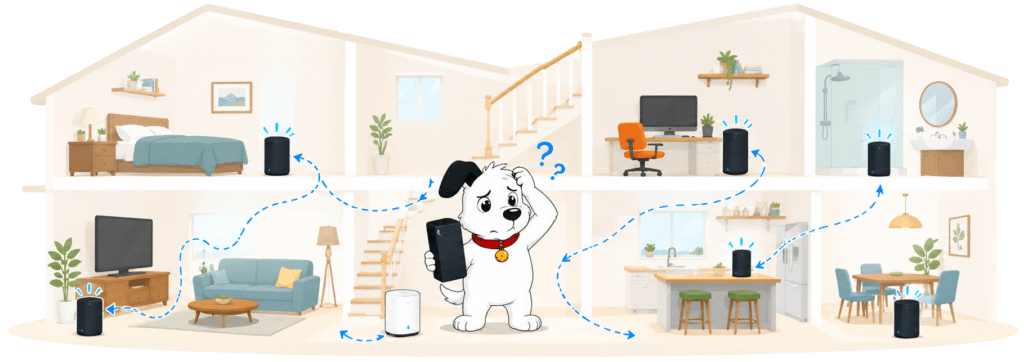
EE WiFi Extenders aren’t included with every package, though. The Smart Hub 7 Plus pairs with the WiFi Extender 7 Plus, while the Smart Hub 7 Pro pairs with the WiFi Extender 7 Pro. Both are excellent, and which one you get will be determined ultimately by the speed of package you pick. Anything less than 1.6Gbps doesn't really need the Pro versions.
INTERACTIVE TOOL
Whole Home Wi-Fi Calculator
Just follow these simple steps and we will calculate how many, if any, ‘Whole Home Wi-Fi’ pods you will need from your provider.
Start here. Work through the steps in order.
Step 1: Agree to M-Lab’s data policy
M-Lab stores test data, including your IP address. Tick to agree before testing.
Step 2: Connect to your home Wi-Fi
Make sure the phone, tablet or laptop you are using is connected to your home Wi-Fi network.
Step 3: Turn mobile data off
If your device has mobile data, turn it off before you start walking around the house.
Step 4: Test next to your router
Stand next to your main Wi-Fi router and press the button below. This gives us your baseline speed.
Step 5: Test your ground floor corners
Walk to each corner of your ground floor and run a test. If your home is not a perfect rectangle, do not overthink it. Just pick four sensible far-apart spots and keep the same numbering if you add another floor.
Last step: Add another floor or calculate
If you have another floor to test, add it below. If you have tested every floor you care about, press calculate.
Your Whole Home Wi-Fi result
Where would you like to go next?
Range is very good, but your walls still matter
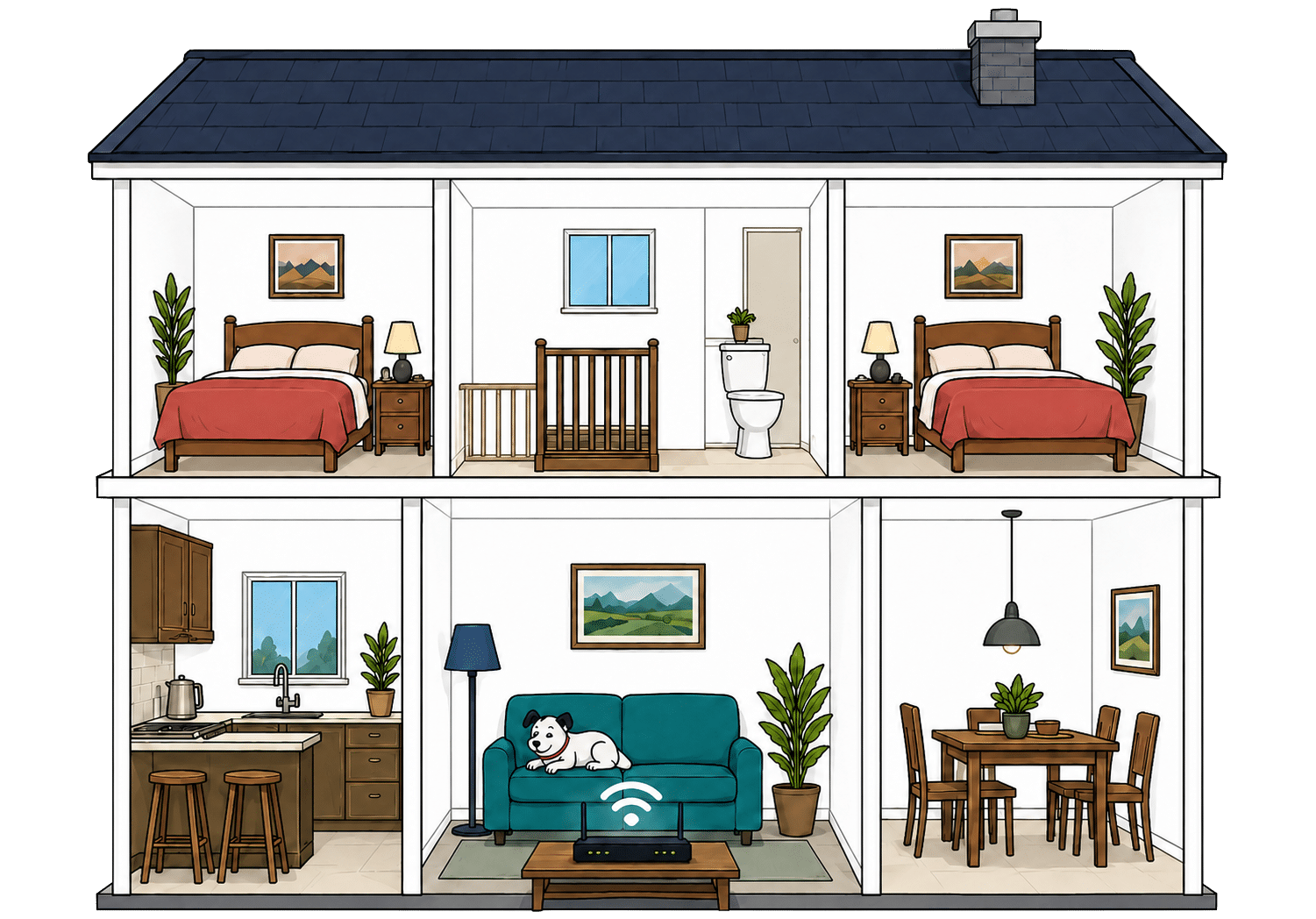
EE’s routers have very good range, but your home gets the final say. The Smart Hub 7 Plus has six antennas, while the Smart Hub 7 Pro has eight and adds 6GHz Wi-Fi for faster short-range connections. That’s serious business, but the router still has to push signal through brick, stone, mirrors, insulation, distance and whatever other weirdness your house might be hiding.
Range problems are usually home problems, not just router problems. Thick walls, old brick, stone, mirrors, insulation and distance can all hurt your Wi-Fi's ability to travel at speed. EE's answer is its WiFi Extender setup, especially where whole-home coverage matters more than raw speed.
INTERACTIVE TOOL
Router range estimator
See how wall materials and router choice affect the quality of Wi-Fi around a typical home.
Where would you like to go next?
EE is very good if you still use cables
The Smart Hub 7 Plus gives you three usable Gigabit LAN ports and one spare 2.5Gbps port once the ONT connection has used its own 2.5Gbps port. That’s enough for TVs, games consoles, desktop PCs, network switches and anything else that behaves better on a cable than on Wi-Fi.
The Smart Hub 7 Pro gives faster wired devices the ports they need. Once the ONT is connected, you still have four usable 2.5Gbps LAN ports. That suits a fast desktop PC, NAS, serious home office, wired switch or EE’s 1.6Gbps package. For gaming, big downloads and work devices, Ethernet is still the boring answer that works.
How a simple wired EE broadband network works
Plugging devices directly into your router gives them a steadier connection than Wi-Fi. These router diagrams show the physical Ethernet ports, including any ONT or internet port used by the broadband connection itself.
Check which port is the internet input before counting how many wired device ports you have spare.
Use the fastest spare LAN port for the device or switch that needs the most speed.
Router controls are good, but hardly nerd heaven
EE gives you the controls you’re likely to use day to day. You get app management, browser admin, parental controls, guest Wi-Fi, QoS, smart channel selection, security features, automatic updates, WPS and a physical reset button. The app handles simple jobs. The browser admin page gives you deeper settings when you need them.
EE doesn’t include per-device prioritisation or a physical Wi-Fi on/off button. If you want to give your work laptop or games console first dibs on the connection, that’s going to be frustrating. If you just want to change your Wi-Fi details, set up guest access, check connected devices and keep your network safe, EE lets you do it without turning its router page into the cockpit of a commercial passenger jet.
EE Broadband router controls at a glance
Here’s a quick look at the router controls you can expect, including app management, browser admin tools, Wi-Fi settings, security features and the physical buttons on the router itself.
Checked from manufacturer specifications. Fibredog tracks dozens of router specification parameters across dozens of provider routers. When a provider changes its router or features, this table is swiftly updated.
Using your own router is easy on EE
EE makes adding your own third-party router very easy, because the router EE sends you doesn’t have to be involved at all. The fibre line arrives at an ONT on your wall, and your own router connects to that via Ethernet. You’re not using the EE router as a modem. You’re directly replacing it.
Nine times out of ten, you wouldn’t bother adding your own router anyway, because the routers supplied by EE are simply fantastic. It makes sense if you already own a high-end mesh system, need specialist VPN, DNS, VLAN or firewall features, prefer different parental controls, or want your existing home network left alone. Once you make the swap, setup and troubleshooting are on you.
Value for money
Value for money is not just the monthly price staring at you on the checkout page. EE’s packages change shape as you add routers, Wi-Fi extras, security, backup options, price rises, renewal rules and service guarantees. It isn’t about chasing the cheapest headline price – that's a moving target there's no hope of hitting. So this section looks instead at what you actually get for your money, what's included, what's sat behind a paywall, and where EE is better value than it might at first appear to be.
EE covers the essentials well, but there's a lot of good stuff behind a paywall
EE gives you plenty before you add paid extras. App controls, parental controls, guest Wi-Fi, router security and automatic firmware updates are all included as standard. 'Core' doesn’t feel like bare bones in desperate need of meat. It still gives you the broadband service, the Smart Hub 7 Plus or Pro, and EE’s personalised speed guarantee.
That said, EE does put some of the better stuff aside for those willing to pay a bit more. The EE WiFi Optimiser, Connectivity Backup, Norton Cyber Security, and the more advanced EE WiFi Extenders sit with Standard, Premium, or Ultimate. So the package that looks the cheapest isn’t necessarily going to offer the best value, depending of course on what you actually need.
What you get with EE Broadband
Here’s what's included as standard, what may cost extra, and what's only free on top-end packages.
Standard kit versus paid extras
This table separates everyday included features from extras that may depend on package tier, router choice or paid add-ons.
Good to know: Included features are easier to compare because you won’t need to budget for them separately.
Worth checking: Some useful extras may only be included on selected packages or as paid add-ons.
EE’s annual rise is simple, visible and annoying
Firstly, we'll hand EE some credit here because at least the April increase is no longer hidden behind complex inflation maths. Secondly, we're going to snatch that credit back again because it's being forced to do it by Ofcom.
On all EE packages, your bill goes up by a fixed £4 a month every April. You know that before you sign up, which makes it much easier to understand than the old percentage-plus-inflation approach.
Clearer doesn’t mean cheaper, though. If you take a 24-month deal, year two will cost you £48 more (for the whole year) than year one. And that's before you factor add-ons, extras or package changes. So the checkout price is only the opening number. The real price is what you’ll actually pay across the full minimum term. We do wish providers would just stop all this nonsense and just have fixed-price contracts. We can dream, can't we?
INTERACTIVE CHART
How much will your bill rise by?
This interactive chart shows how much this provider adds to its package prices each April, and lets you compare that with literally any other provider in our database.
Package annual price rises
April price rise shown package by package
The provider-average benchmark is calculated from each provider that applies an annual price rise. Fixed-price providers are shown in the chart but are excluded from the benchmark.
EE’s add-ons are worth checking out, but think carefully about what you need
EE’s checkout price is not always the real price you'll end up paying, because some useful extras sit behind upgrades or add-ons. The premium router option is the big one. EE’s top router is genuinely better, not just a shinier version of the same thing, but it only makes any sort of sense on packages of 900Mbps or higher.
Cyber Security depends on whether you actually want Norton-powered protection – and you should trust us when we tell you you probably don't. EE doesn’t offer a static IP on normal home broadband either, so there’s no point hunting for one at checkout. Pick your package first, then add only the extras that solve a real problem.

EE’s rollover trap is milder than most, but it is still a trap
EE looks better than many rivals when your minimum term ends. Your bill doesn’t suddenly rocket onto a standard tariff that looks like punishment for forgetting a date. EE says the out-of-contract rise is capped at £4 a month, so the rollover sting is smaller and easier to predict.
Doing nothing still usually means paying more than you need to. EE has to warn you before the minimum term ends, but that warning is your cue to move, not background noise for the recycling bin. Check EE’s renewal price against its current new-customer deals, then compare it with other providers too. If EE offers you a better deal, fine. If it doesn’t, a capped increase is still money you don’t need to hand over. EE isn’t being outrageous here. It really isn’t. But letting any broadband contract roll on quietly is rarely the cheapest way to stay connected.
INTERACTIVE TOOL
What could your broadband bill roll on to?
Estimate what your monthly broadband price could look like by the end of your minimum term, and what it will jump to if you let the deal roll over.
Step 1: Choose your provider and package
Start by choosing your broadband provider, then select the package your contract is based on.
Step 2: Tell us the starting month of your contract and what you pay
Use the first full monthly price before any mid-contract April increases.
Step 3: Estimate the rollover shock
This is an estimate. Your provider’s end-of-contract notice will be the exact figure.
Your estimate
Where would you like to go next?
EE’s guarantees have real substance
EE gives you a personalised minimum-speed promise before you sign up. That beats the broadband habit of waving the word ‘fast’ around and hoping nobody asks for a number. EE is also signed up to Ofcom’s speed code, so below-guarantee speeds to your hub have to be investigated, not shrugged off.
If EE doesn’t fix a qualifying speed fault within 30 days, you get the right to leave without an early exit fee. Some premium packages add a Wi-Fi guarantee too, with up to £100 if checks still show weak coverage inside your home.
INTERACTIVE TOOL
Are you getting your minimum guaranteed speed?
Choose your provider and package, then run a speed test. For the cleanest test of the broadband speed coming into your home, plug a laptop or desktop directly into your router with a LAN cable. You can also test on a phone or tablet to check Wi-Fi speed, but make sure mobile data is switched off first.
Choose your provider and package
Choose your provider and package so we can compare the test result with the package's minimum guaranteed download speed.
Before you test
For an absolute line-speed check, use a computer connected to the router by Ethernet. If you test over Wi-Fi, the result may reflect your in-home Wi-Fi as much as the broadband line itself.
Run the speed test
Ready. Select a package, tick the data policy box, then run the test.
Your result
Where would you like to go next?
This tool uses M-Lab’s open measurement platform. A single speed test is a useful check, but it is not a formal fault diagnosis.
EE’s bundled routers are unusually good value
Most providers treat the included router like a cost-cutting exercise. EE does not. The Smart Hub 7 Plus is one of the best routers supplied by any major broadband provider, with Wi-Fi 7, app controls, parental controls, security features and enough wired ports for whoever needs it. It doesn't behave like a free router at all.
The Smart Hub 7 Pro is where the value gets a bit silly. It adds tri-band Wi-Fi, 6GHz support, more antennas and far better wired connectivity. Most people get the Plus, which is already excellent. The Pro is reserved for 1.6Gbps or sold as an upgrade, which is exactly where it belongs. If you want to match the specs of the Pro with a router you bought yourself, you're going to be spending hundreds.
Having trouble choosing a broadband provider?
No single best provider or package exists – only the best pick for you personally. Fibredog's YourMatch™ system uses thousands of provider metrics and a lot of maths to find you your perfect match.
Some links on this page may earn us a small commission if you click through and buy. This never affects either what you pay, or our scores and recommendations. If, however, you’d rather bypass affiliate links, use this direct EE Broadband link instead.