THE BIG HEY!BROADBAND REVIEW
Hey!Broadband review: Is it any good?
Hey!Broadband is a very good local Full Fibre provider with excellent uploads, modern routers and customer service that people genuinely like. Its weak guarantees and harsh leaving terms need careful reading, though. This review explains where it excels, where the contract bites and whether it suits your home.

Hey!Broadband overall scorecard
Six key areas. One overall score. All calculated using our transparent methodology.
Packages and speeds
Available speeds, package range, upload speeds, gaming features, working from home suitability and changing your package.
Joining, switching and cancelling
Ease of joining, credit checks, installation, compensation, switching from another provider, moving home and cancelling your service.
Customer service
Customer experience, contact options, when something goes wrong, complaints policy, help for vulnerable customers and online support.
Routers and equipment
Wi-Fi quality, Wi-Fi range, whole-home Wi-Fi, wired connectivity, router controls and using your own router.
Value for money
What comes as standard, included router value, annual price rises, the cost of upgrades and extras, end-of-contract pricing and service guarantees.
Contracts and small print
Your contract commitments, price rise terms, early-exit fees, speed guarantees, equipment ownership, restrictions, penalties and hidden catches.
Fibredog Package Speed Calculator
Enter the number of people, TVs, consoles and so on and we’ll match you with the right package speed.
Fibredog Upload Speed Comparison
Compare any provider's upload speeds with any other as absolute numbers or as a ratio of download speed.
Fibredog Package Change Rules Checker
Answer a few simple questions to see if you should upgrade, downgrade or switch.
Fibredog Interactive Customer Experience Chart
Use the buttons to examine this provider’s customer experience performance in every dimension.
Fibredog Router Comparison Tool
Compare this provider’s routers with each other, or with any other national provider.
Fibredog Whole Home Wi-Fi Calculator
Calculates whether you need additional mesh routers, how many, and even where you should put them.
Fibredog Router Range Estimator
Provides a visual mock-up of how Wi-Fi is likely to behave in your home with this provider’s routers.
Fibredog Exit Fees Calculator
Tell us who you’re currently with and how long there is left on your contract, and we will tell you your early exit fees.
Fibredog Broadband Buyout Calculator
Check whether you’re in the zone where you can make good use of this provider’s broadband buyout offer.
Fibredog Annual Price Rise Comparison
See how much each of these provider’s packages will go up every April and compare that to any other provider.
Fibredog Rollover Price Calculator
Tell us who you’re with and what you’re paying and we will tell you how much your price will go up when your contract ends.
Fibredog Speed Guarantees Test
Tell us who you’re with and we will check if they’re delivering you the minimum speed they promised.
Joining, switching and cancelling
Joining and switching to Hey!Broadband are easy. You can place the whole order online, One Touch Switch handles the old service and qualifying customers can get a broadband buyout. Moving, installation problems and cancellation are much less forgiving.
You can check availability and place the whole order online
Because Hey!Broadband only covers certain areas, the postcode checker has to come first. If your exact address qualifies, you can choose the package and complete the order online without sitting through a sales call.
Phone, callback and Live Chat are there if you want help before committing. Passing the postcode check doesn’t guarantee that your property can be connected, as the final survey may uncover access, safety or construction problems. Be honest about the building and get your landlord’s permission beforehand if you rent, because special work or a failed visit can create avoidable costs.
INTERACTIVE TOOL
What could your broadband bill roll on to?
Estimate what your monthly broadband price could look like by the end of your minimum term, and what it will jump to if you let the deal roll over.
Step 1: Choose your provider and package
Start by choosing your broadband provider, then select the package your contract is based on.
Step 2: Tell us the starting month of your contract and what you pay
Use the first full monthly price before any mid-contract April increases.
Step 3: Estimate the rollover shock
This is an estimate. Your provider’s end-of-contract notice will be the exact figure.
Your estimate
Where would you like to go next?
Hey!Broadband won’t say whether its credit check is hard or soft
Hey!Broadband tells you that it will run a credit check before accepting the order. What it doesn’t say is whether that search is hard or soft, which is important if you’re trying to protect your credit file.
A failed assessment can stop the order, and there’s no published alternative involving a deposit, advance payment or package without a credit check. Everyday Fibre, the social tariff, doesn’t avoid the assessment either. Most applicants may pass without drama, but anyone who has been refused broadband before gets too little information and no obvious fallback.
One Touch Switch does most of the switching work for you
Give Hey!Broadband your old provider’s details when you order and it can arrange the switch, including closing the previous service. That removes the awkward job of coordinating two providers yourself.
If you use One Touch Switch and take a 24-month contract, Hey!Broadband currently gives you a £100 broadband buyout as a bill credit after activation. It’s applied automatically, so you don’t need to send in your old provider’s final bill. Check that the old service actually closes and don’t cancel it yourself unless Hey!Broadband tells you to, or you could interrupt the managed switch.
COMPARISON CHART
How much will Hey!Broadband pay to buy you out?
This chart shows which providers currently offer broadband contract buyout, and how much they may pay toward leaving your old contract.
Broadband contract buyout by provider
Maximum buyout amount by provider
Where would you like to go next?
The national average benchmark only includes providers that currently offer broadband contract buyout in our database.
A move inside the network is manageable, but leaving it can be expensive
Tell Hey!Broadband before moving so it can check the new address and arrange another installation. If service is available, the move may start a fresh minimum term, so ask for the new end date before agreeing.
The real problem comes if your new home is outside the network. Hey!Broadband can still charge the remaining contract balance even though it can’t serve the new property. That is especially harsh for a local provider with a limited footprint. If there’s any chance you’ll move during the next two years, a 12-month or rolling contract may be worth more than the cheapest headline deal.
Cancelling is straightforward only when the contract has already finished
You can cancel through customer service, and One Touch Switch should handle it when you move to another provider. Cancelling during the minimum term is much tougher. Hey!Broadband can ask for every monthly payment left, and it doesn’t publish a standard deduction for the money it saves after your service ends.
You’ll also need to return the router and any other loaned equipment within 14 days, at your own expense. Use tracked post and keep the receipt until the final account is settled, because missing or damaged equipment can add another charge after you leave.
Cancelling Hey!Broadband at a glance
A quick view of the routes, notice periods, fees and equipment-return rules you may need to deal with.
Installation is easy until the property needs something unusual
Full Fibre may need a new cable route, a small box inside the home and drilling through an outside wall. Decide where the equipment should go, clear the likely route and make sure an authorised adult can let the engineer in.
Hey!Broadband doesn’t pay automatic compensation for a delayed start or missed appointment. A failure caused by the provider should normally bring a refund, but completed preparation, inaccurate property information or work you requested can still leave a bill. Get any non-standard work and cost confirmed in writing before it starts, particularly if the survey finds a blocked route or permission problem.
Customer service
Hey!Broadband’s people are one of its best features. Customers praise the engineers and support staff, phone and Live Chat stay open for long hours, and complaints are handled through a clear process. Its online account tools are years behind.
Customers are unusually positive about the people working at Hey!Broadband
Hey!Broadband has some of the best public reviews we’ve seen for a UK broadband provider. Installers receive particularly warm praise for arriving on time, working neatly and explaining what they’ve done.
Support advisers are often described as patient and quick to solve faults too. Trustpilot isn’t a representative Ofcom survey, so it can’t tell us what every customer thinks. The unhappy minority also describes real problems with recurring outages, muddled communication and bills. Even with those cautions, the volume and detail of the positive reviews are hard to dismiss.
INTERACTIVE CHART
Interactive Hey!Broadband customer experience chart
You can use the various buttons here to see the Hey!Broadband customer experience in a number of different ways.
Overall service satisfaction
Ofcom satisfaction with service overall
Sources: Ofcom, Trustpilot.
You can reach a person without rearranging your entire day
Phone and human Live Chat are open for 80 hours each week, including evenings and weekends. Email and web forms give you a written option when the problem isn’t urgent or you want a record.
That choice suits people who would rather explain a problem to somebody than wrestle with an app. There’s no supported WhatsApp or social-media help, but you can still contact Hey!Broadband in all the usual ways. The bigger problem is that staff must also handle routine requests that a decent online account should let you complete yourself.
Support channels at a glance
Hey!Broadband gives customers several ways to get help. This view shows which practical contact, account and fault-support routes are recorded in the fibredog dataset.
Checked from live provider data. Fibredog tracks contact routes, account tools and fault-help options separately, so this information updates soon after anything changes.
Faults are easy to report, but repair promises are weak
The status checker can show a wider local outage, while online troubleshooting helps separate a device or Wi-Fi problem from a broken connection. You can then create a support ticket online or phone the team.
What happens afterwards is less reassuring. There’s no automatic compensation, fixed repair deadline or home-broadband backup. You only gain a clear fee-free exit after 30 continuous days without service. Report a fault immediately and keep the ticket details, especially because there’s no customer portal showing a complete case history.
Useful personal support comes with some important accessibility gaps
A specialist team can record what help you need, let somebody you trust speak for you and support customers after a bereavement or during financial difficulty. Text Relay is available too.
Hey!Broadband also has a social tariff for eligible households. What it doesn’t promise is priority fault repair, a BSL contact service or bills in Braille, large print or audio. Those omissions matter most to people who can’t simply switch to an ordinary phone call or wait through an outage without extra risk.
Help with complaints
The specialist team can record your communication needs and let a nominated person speak for you throughout a complaint.
The complaints policy tells you exactly how to escalate
You can complain by phone, email, web form or post. Hey!Broadband aims to confirm receipt within two working days, gives you a named way to request a senior review and explains when outside adjudication becomes available.
After six weeks, or sooner if you receive a deadlock letter, you can take the dispute to CISAS. Few providers explain that escalation so clearly. Hey!Broadband does allow itself up to 28 working days for a full response, though. You may wait too long, but you shouldn’t be left wondering what the next step is.

Independent ADR provider
If Hey!Broadband can’t resolve your complaint, CISAS is the approved ADR scheme for its broadband services.
- 100 St Paul’s Churchyard, London EC4M 8BU
- 0207 520 3814
- cisas@cedr.com
- cedr.com/consumer/cisas
The missing customer account makes simple jobs unnecessarily difficult
You can check for an outage, read troubleshooting advice and report a fault online. There’s also a help centre, but it has no search box, and there’s no customer login, account app or chatbot.

That means you may need to contact staff to check an old bill, follow a case or make changes to the account. It’s a remarkable gap for a broadband provider and the clearest weakness in an otherwise good service. Hey!Broadband says it’s working on an online account, but you can only use what’s available today.
Routers and equipment
Whichever service you choose, Hey!Broadband supplies a modern Wi-Fi 6 router with WPA3 security and automatic updates. The exact model depends on whether you take standard broadband, a home phone or managed mesh. They’re all good, but they don’t offer identical sockets or controls.
Every customer gets a router that is genuinely worth using
The Linksys SPNMX56HF-UK, Adtran 854-v6 and Nokia WiFi Beacon 3.1 all support Wi-Fi 6, WPA3, beamforming, MU-MIMO and OFDMA. Nobody is quietly handed an obsolete bargain-bin router for choosing the cheapest speed.
None uses the newer 6GHz band or Wi-Fi 7, but that won’t bother most households. The more important differences are practical. The Linksys has a polished app and useful coverage, the Adtran includes phone sockets but no supported app or parental controls, and the Nokia is designed to work with Hey!Broadband’s mesh service. Your service choice, not the speed tier, decides which one arrives.
INTERACTIVE TOOL
Compare routers from any provider
This provider’s routers are pre-selected for comparison with one another. However, you can use this tool to compare any router from any major provider using the dropdown menus below.
| Feature | Adtran 854-v6 | Linksys SPNMX56HF-UK |
|---|---|---|
| Fibredog rating | ||
| Router included as standard | Yes; allocated to residential home-phone installations, subject to availability and installation requirements. | Yes; allocated to standard broadband-only installations, subject to availability and installation requirements. |
| Router manufacturer | Adtran | Linksys |
| Router model | 854-v6 | SPNMX56HF-UK |
| Wi-Fi standard | Wi-Fi 6 | Wi-Fi 6 |
| Wi-Fi bands | Dual-band | Dual-band |
| 2.4GHz supported | ✓Yes | ✓Yes |
| 5GHz supported | ✓Yes | ✓Yes |
| 6GHz supported | ×No | ×No |
| Beamforming | ✓Yes | ✓Yes |
| Antenna count | 9 | 5 |
| Maximum connected devices | Up to 100 | Up to 30 |
| Stated coverage | 360-degree coverage; no quantified floor-area figure published | Up to 2,700 sq ft (about 251 m²) per node |
| Total Ethernet ports | 5 | 4 |
| MU-MIMO | ✓Yes | ✓Yes |
| OFDMA | ✓Yes | ✓Yes |
| WPA3 security | ✓Yes | ✓Yes |
| Guest network | ✓Yes | ✓Yes |
| Antenna type | Internal H-Pol omnidirectional antennas | Internal dipole and metal antennas |
| Gigabit Ethernet ports | 4 | 3 |
| 2.5Gb Ethernet ports | 1 | 1 |
| 5Gb Ethernet ports | 0 | 0 |
| 10Gb Ethernet ports | 0 | 0 |
| WAN port speed | 2.5Gbps | 2.5Gbps |
| USB ports | 1 | 0 |
| Telephone ports | 2 | 0 |
| ONT Ethernet input | ✓Yes | ✓Yes |
| Coaxial input | ×No | ×No |
| Power connection | 12V DC barrel connector / external power adapter | 12V DC barrel connector / external power adapter |
| Mesh support | Provider mesh add-ons | Provider mesh add-ons |
| Provider mesh product | Mesh WiFi (Nokia WiFi Beacons) | Mesh WiFi (Nokia WiFi Beacons) |
| Third-party router use | You can use your own router | You can use your own router |
| Modem mode | ✓Yes | ✓Yes |
| Compatible broadband technology | fttp | fttp |
| App management | ×No | ✓Yes |
| Parental controls | ×No | ✓Yes |
| QoS | ✓Yes | ✓Yes |
| Automated QoS | ✓Yes | ×No |
| Device prioritisation | ×No | ✓Yes |
| Anti-bufferbloat controls | ×No | ×No |
| Manual queue management (SQM/CAKE) | ×No | ×No |
| Smart channel selection | ✓Yes | ✓Yes |
| Security features | WPA3; firewall; NAT/NAPT; access-control lists; VPN pass-through; DMZ; port forwarding; guest network | WPA2/WPA3; safe browsing; firewall; guest network; parental controls; device prioritisation |
| Gamer mode | ×No | ×No |
| Game traffic prioritisation | ×No | ×No |
| Gaming QoS profiles | ×No | ×No |
| Server ping routing tools | ×No | ×No |
| Latency dashboards | ×No | ×No |
| Per-device gaming presets | ×No | ×No |
| Gaming VPN routing features | ×No | ×No |
| Work from home mode | ×No | ×No |
| Automatic firmware updates | ✓Yes | ✓Yes |
| Firmware update notes | The model supports provider-managed TR-069 firmware delivery; Hey!Broadband does not publish a customer update schedule. | The Hey!Broadband-specific firmware supports automatic configuration through ACS/TR-069 and Linksys firmware updating; Hey!Broadband does not publish an update schedule. |
| Router height | 249mm | 185mm |
| Router width | 90mm | 86mm |
| Router depth | 195mm | 86mm |
| Router weight | 1176g | 500g |
| Power consumption | 36W | 24W |
| Router orientation | Vertical | Vertical |
| Wall mountable | ✓Yes | ×No |
| Router colour | White | White |
| Self-installation | ✓Yes | ✓Yes |
| Browser admin interface | ✓Yes | ✓Yes |
| WPS | ✓Yes | ✓Yes |
| Status light control | ×No | ×No |
| Reset button | ✓Yes | ✓Yes |
| Wi-Fi on/off button | ×No | ×No |
| Where would you like to go next? | See all tools | See all tools |
| Compare all broadband deals | ||
The Nokia mesh can cover homes one router can’t
Mesh WiFi includes a Nokia Beacon extender, while Wi-Fi Pro can use up to three Beacons around the home. Because the router and extra units belong to one system, devices can move between them without joining separate networks.
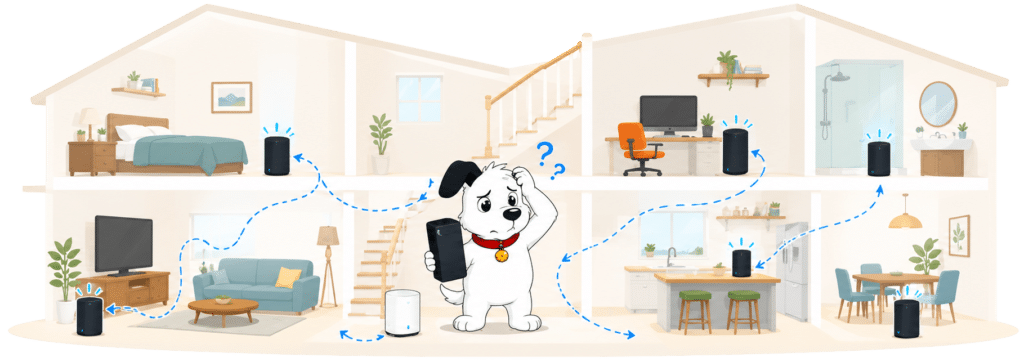
That can be valuable in a long house, across several floors or anywhere thick walls defeat a single router. It isn’t included with ordinary broadband, though, and adding it later means changing the router. There’s also no minimum room-by-room speed, refund or other measurable promise if coverage still disappoints. Buy it for extra reach, not as a guarantee.
INTERACTIVE TOOL
Whole Home Wi-Fi Calculator
Just follow these simple steps and we will calculate how many, if any, ‘Whole Home Wi-Fi’ pods you will need from your provider.
Start here. Work through the steps in order.
Step 1: Agree to M-Lab’s data policy
M-Lab stores test data, including your IP address. Tick to agree before testing.
Step 2: Connect to your home Wi-Fi
Make sure the phone, tablet or laptop you are using is connected to your home Wi-Fi network.
Step 3: Turn mobile data off
If your device has mobile data, turn it off before you start walking around the house.
Step 4: Test next to your router
Stand next to your main Wi-Fi router and press the button below. This gives us your baseline speed.
Step 5: Test your ground floor corners
Walk to each corner of your ground floor and run a test. If your home is not a perfect rectangle, do not overthink it. Just pick four sensible far-apart spots and keep the same numbering if you add another floor.
Last step: Add another floor or calculate
If you have another floor to test, add it below. If you have tested every floor you care about, press calculate.
Your Whole Home Wi-Fi result
Where would you like to go next?
Your chosen services decide which of the three routers arrives
Standard broadband customers receive the Linksys. Add a home phone and the Adtran takes over because it has the necessary phone sockets. Choose managed mesh and you get the Nokia system instead.
That is a genuine choice at sign-up, even though you can’t simply point at your favourite model. The arrangement also explains why three routers support three packages: they aren’t matched to speed. Before ordering an add-on, look at the router it brings with it as well as the service itself, particularly if parental controls, an app or spare Ethernet sockets matter to you.
INTERACTIVE TOOL
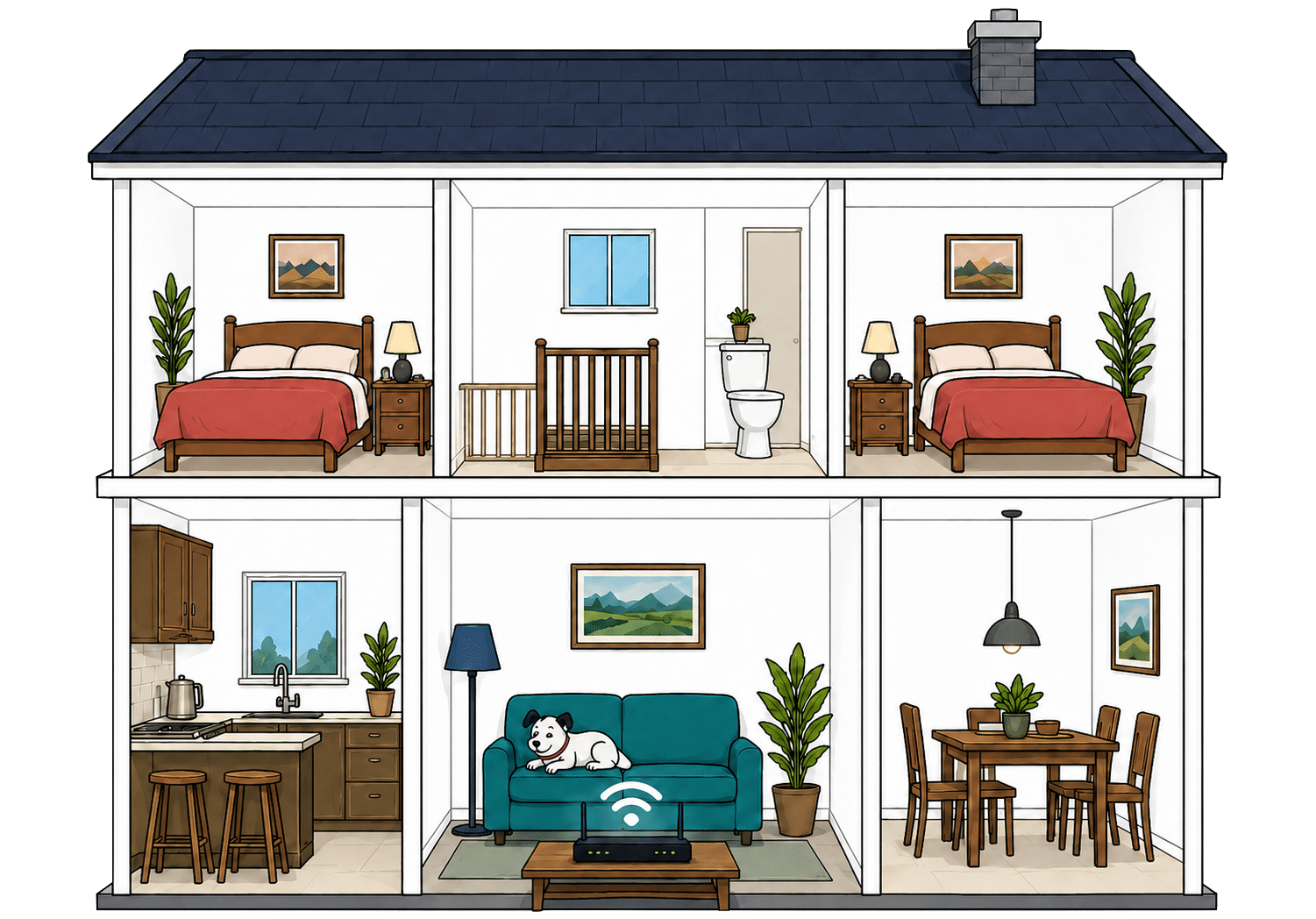
Router range estimator
See how wall materials and router choice affect the quality of Wi-Fi around a typical home.
Where would you like to go next?
Gigabit Ethernet covers every current Hey!Broadband package comfortably
The Adtran gives you four Gigabit LAN ports and the Linksys has three, while the Nokia leaves fewer spare sockets once it is connected. Every current package can run at full speed through those ports.
The Linksys and Adtran can accept a 2.5Gbps connection from the fibre box, but none can send more than 1Gbps to one wired device. That only becomes a real limit if Hey!Broadband launches a package above 1Gbps or you run unusually fast equipment inside the home. If the problem is simply too few sockets, an inexpensive Ethernet switch is easier than replacing the router.
How a simple wired Hey!Broadband network works
Plugging devices directly into your router gives them a steadier connection than Wi-Fi. These router diagrams show the physical Ethernet ports, including any ONT or internet port used by the broadband connection itself.
Use a wired connection for TVs, consoles and computers that stay in one place.
Use the fastest spare LAN port for the device or switch that needs the most speed.
Everyday controls are good, but enthusiasts will want more
Linksys and Nokia provide useful apps, and every router also has a browser settings page, guest Wi-Fi, WPA3 security and automatic firmware updates. That covers what most households actually need.
Home-phone customers lose the supported app and parental controls with the Adtran. Across all three models, detailed traffic management and dedicated gaming features are limited. If you want anti-bufferbloat settings, sophisticated quality-of-service rules or complete control over firmware, use your own router instead.
Hey!Broadband router controls at a glance
Here’s a quick look at the router controls you can expect, including app management, browser admin tools, Wi-Fi settings, security features and the physical buttons on the router itself.
Checked from manufacturer specifications. Fibredog tracks dozens of router specification parameters across dozens of provider routers. When a provider changes its router or features, this table is swiftly updated.
Using your own router is refreshingly easy
Hey!Broadband offers a free bridge mode service, allowing your own router to take over the Wi-Fi, Ethernet and network controls. This is official support rather than a fragile workaround hidden in an online forum.
Hey!Broadband continues to look after the fibre connection, while you configure and support the router you chose. That’s fair, and it’s more flexible than many providers. Requesting bridge mode after installation can mean returning equipment or arranging an engineer visit, so mention it before the installation if you already know you’ll use different hardware.
Value for money
Hey!Broadband is good value if you mainly want a fast connection and a decent router. Uploads are as fast as downloads, the annual increase is lower than most and the price doesn’t shoot up when the contract ends. Mesh Wi-Fi, a phone and security can still make the bill noticeably larger, while the service guarantees offer very little comfort.
The standard package includes the things most people actually need
Every package includes symmetrical Full Fibre and a proper Wi-Fi 6 router. Those are useful benefits, not decorative freebies, and they come with the entry tier as well as the fastest deal.
The bundle becomes less generous when your household needs more than broadband. Mesh Wi-Fi, a home phone, Norton security, a static IP address and mobile service all cost extra, while automatic broadband backup isn’t available at all. That makes Hey!Broadband best suited to people who already have their other household services sorted and don’t need a bundle full of additions.
What you get with Hey!Broadband
Here's what's included as standard, what may cost extra, and what's included with premium packages.
Standard kit versus paid extras
This table separates everyday included features from extras that may depend on package tier, router choice or paid add-ons.
Good to know: Included features are easier to compare because you won’t need to budget for them separately.
Worth checking: Some useful extras may only be included on selected packages or as paid add-ons.
The April price rise is small, clear and still unwelcome
The monthly package price rises by £2 each April. We’d rather the price stayed fixed, obviously, but a fixed cash amount is much easier to understand than an inflation formula you can’t calculate in advance.
The same rise applies to standard packages regardless of speed, so you can work it out before deciding whether the deal fits your budget. That’s much clearer than a percentage increase. It doesn’t freeze every other charge, though: extras and one-off fees can change separately, while the contract leaves room for other changes in certain circumstances.
INTERACTIVE CHART
How much will your bill rise by?
This interactive chart shows how much this provider adds to its package prices each April, and lets you compare that with literally any other provider in our database.
Package annual price rises
April price rise shown package by package
The provider-average benchmark is calculated from each provider that applies an annual price rise. Fixed-price providers are shown in the chart but are excluded from the benchmark.
Buy an extra only when you can name the problem
Managed mesh can solve weak coverage, a home phone suits people who still use one, and a static IP address has specific technical uses. None is automatically poor value. The mistake is adding several at checkout because they sound reassuring, then discovering that the attractive broadband deal has become a much larger monthly commitment.
The broadband and router are the sensible starting point. An extra is worth adding only if it solves a real problem in your home. More speed won’t fix weak Wi-Fi, Norton may duplicate security you already have and Hey!Broadband’s mobile SIM is a separate mobile service rather than automatic backup for the router. When you compare providers, use the total monthly cost after adding everything your home needs.

Rollover pricing is comparatively restrained, but doing nothing still costs more
When the minimum term ends, the service continues on a monthly basis and the typical increase is modest beside the jumps imposed by some larger providers. One accidental month shouldn’t wreck the household budget.
You should still act, because paying more for the same broadband is hardly a loyalty reward. Hey!Broadband should warn you around 30 days before the contract ends. Use that notice to compare alternatives and ask what it will offer to keep you. Returning to a discounted deal normally means accepting another minimum term.
INTERACTIVE TOOL
What could your broadband bill roll on to?
Estimate what your monthly broadband price could look like by the end of your minimum term, and what it will jump to if you let the deal roll over.
Step 1: Choose your provider and package
Start by choosing your broadband provider, then select the package your contract is based on.
Step 2: Tell us the starting month of your contract and what you pay
Use the first full monthly price before any mid-contract April increases.
Step 3: Estimate the rollover shock
This is an estimate. Your provider’s end-of-contract notice will be the exact figure.
Your estimate
Where would you like to go next?
The guarantees are poor
Hey!Broadband will investigate low speeds, but it doesn’t publish an enforceable minimum, a low-speed repair deadline or an automatic right to leave when repeated tests fall short. Paying for mesh doesn’t create a measurable room-by-room promise either.
A total outage brings no automatic compensation or guaranteed repair time. The clearest fee-free exit only arrives after 30 continuous days without service. That leaves customers depending on their own records and the complaints process when something serious goes wrong, which is a weak safety net for an essential household service.
INTERACTIVE TOOL
Are you getting your minimum guaranteed speed?
Choose your provider and package, then run a speed test. For the cleanest test of the broadband speed coming into your home, plug a laptop or desktop directly into your router with a LAN cable. You can also test on a phone or tablet to check Wi-Fi speed, but make sure mobile data is switched off first.
Choose your provider and package
Choose your provider and package so we can compare the test result with the package's minimum guaranteed download speed.
Before you test
For an absolute line-speed check, use a computer connected to the router by Ethernet. If you test over Wi-Fi, the result may reflect your in-home Wi-Fi as much as the broadband line itself.
Run the speed test
Ready. Select a package, tick the data policy box, then run the test.
Your result
Where would you like to go next?
This tool uses M-Lab’s open measurement platform. A single speed test is a useful check, but it is not a formal fault diagnosis.
The included router adds real value whichever speed you choose
All three supplied models use Wi-Fi 6 and WPA3, with useful wired connections and automatic updates. The model follows your chosen service rather than the package speed, so somebody buying Superfast 150 isn’t given old equipment simply because they spend less on the broadband. Most homes can use what arrives instead of immediately buying a replacement.
The differences still deserve attention. Home-phone customers get the Adtran without an app or parental controls, while managed mesh customers receive the Nokia system. There’s no premium Wi-Fi 7 upgrade, but officially supported bridge mode makes it unusually easy to use your own router if you want capabilities the supplied hardware lacks.
Some links on this page may earn us a small commission if you click through and buy. This never affects either what you pay, or our scores and recommendations. If, however, you’d rather bypass affiliate links, use this direct Hey!Broadband link instead.